Table of Contents
ToggleBy: Lucie Blahova
Marketing Lead MEmob
Published: July 22nd 2026
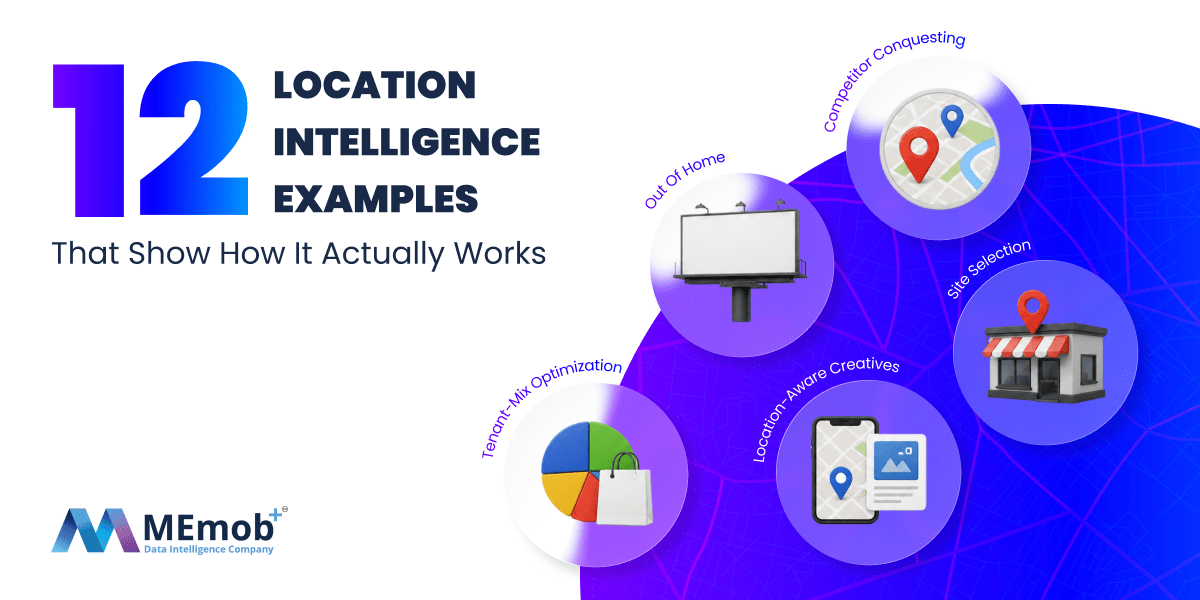
Location intelligence sounds abstract until you see it applied. In practice, it means concrete plays: measuring whether ads drove store visits, targeting a competitor’s customers, or choosing a store site based on real footfall. Here are twelve examples of location intelligence in action; what each one does, and the decision it improves.
Every example below runs on the same foundation: anonymized, privacy-compliant mobility signals matched to verified points of interest.
(New to the concept? Start with our guide: Geospatial Intelligence vs Location Intelligence.)
1. Footfall attribution for ad campaigns
A brand runs a digital campaign, then measures how many exposed users subsequently visited its stores compared with a control group. This isolates the extra visits the media actually produced. It’s the example that converts skeptics, because it puts a store-visit number on digital spend.
2. Competitor conquesting
A QSR chain builds an audience of devices observed at rival restaurant locations ,and serves them offers timed to meal decisions. The targeting criterion isn’t claimed interest; it’s proven visitation behavior.
3. Site selection for a new store
A retailer scores three candidate sites on observed foot traffic, target-audience density, and competitor catchment overlap; replacing “population within 5km” guesswork with evidence of who actually passes each site.
4. Trade area analysis
A mall operator maps where its visitors genuinely come from, discovering that 30% of weekend traffic travels from a district its media plan ignored. Budget moves; footfall follows. (Catchment Area)
5. Out-of-home (OOH) planning and measurement
An advertiser selects billboard locations based on the audience profiles that actually pass them, then measures store visits among exposed audiences bringing digital-grade measurement to the region’s booming DOOH inventory.
6. Ramadan and seasonal pattern analysis
A retailer quantifies how visitation shifts during Ramadan; evening compression, late-night peaks, pre-Eid surges by market and mall, and reflows media flighting and staffing to match. A distinctly MENA example global playbooks miss.
7. Tourism visitor origin analysis
A destination marketing organization identifies which source markets its visitors arrive from and which attractions they combine, redirecting international campaign spend toward the origins that convert. (Beyond Social Profiles)
8. Event impact measurement
A city hosts a major exhibition and measures the visitation lift across hotels, malls, and restaurants during and after turning “the event felt busy” into a defensible economic-impact number.
9. Audience segmentation from real-world behavior
A bank builds a premium prospect segment from devices that frequent luxury malls, five-star hotels, and business districts behavioral evidence of affluence that declared data can’t match then activates it programmatically.
10. Delivery zone and dark-store optimization
A grocery delivery player analyzes demand density and movement patterns to place dark stores where order volume and delivery times optimize spatial logistics powered by the same mobility foundation.
11. Tenant mix optimization
A mall operator identifies which anchor stores actually drive cross-visits to smaller tenants, using the evidence in leasing negotiations and to redesign tenant adjacencies.
12. Location-aware dynamic creative
A campaign automatically adapts its creative to the viewer’s context; nearest branch, local weather, distance-based offers lifting response by making one campaign feel locally made everywhere it runs.
The pattern behind all twelve
Every example follows the same loop: discover an insight from real-world behavior, activate it in media, adapt the creative to context, and measure the physical-world result. Platforms that only deliver the first step leave you with dashboards; platforms that close the loop turn each campaign’s measurement into the next campaign’s targeting. That closed loop AllPings to Excelate to Blueprint to Stretch is how MEmob was built.
Want to see any of these examples running on your market’s data? Book a demo
Frequently Asked Questions
What is an example of location intelligence in everyday business?
Footfall attribution is the most common example: a retailer runs a digital campaign, then measures how many exposed users visited a store compared with a control group. It turns advertising into a measurable driver of physical visits.
What is an example of location data?
An anonymized mobility signal a device observed at a shopping mall at a given time is a typical unit of location data. Aggregated across millions of devices and matched to verified points of interest, these signals reveal visitation patterns without identifying individuals.
How do banks or non-retail businesses use location intelligence?
Businesses without stores use it for audience building and media planning; for example, a bank targeting people who frequent premium venues, or an insurer planning OOH placements along commuter corridors. Behavioral segments built from real-world movement outperform declared-interest data.