Table of Contents
ToggleHow UAE, Saudi & Qatar Brands Reach 49 Million Fans Beyond the Stadium
Map the movement. Activate the moment. Measure the visit.
Executive Summary: The GCC Audience Will Not Watch FIFA 2026 the Same Way
The FIFA World Cup 2026 will be hosted in Canada, Mexico, and the United States, but the marketing opportunity for GCC brands lives at home, across 49 million football fans in the UAE, Saudi Arabia, Qatar, and the wider Gulf.
These fans will not stumble onto matches. They will plan for them in advance. With most kickoffs falling between 11 PM and 5 AM Gulf Standard Time, the GCC audience is making conscious decisions weeks ahead about where to watch, who to watch with, what to eat, where to travel, and which networks, payment methods, and brands to choose.
Across the UAE, Saudi Arabia, Qatar, Kuwait, Bahrain, and Oman, millions of football fans will follow the tournament from public viewing zones, malls, restaurants, sports bars, hotels, fan zones, and homes, even with matches kicking off in inconvenient time zones. Expat communities from team-country populations (Argentina, Brazil, England, France, Morocco, Saudi Arabia itself, and more) will gather in predictable, mappable density across GCC cities.
That planning window is where the commercial opportunity lives.
For GCC brands, the question is not how to reach fans in Dallas or Toronto. It is:
Where do your UAE, KSA, and Qatar audiences move during matchday windows, and how do you turn that movement into measurable footfall, store visits, and incremental revenue?
This playbook gives QSR, retail, telco, banking, automotive, and tourism brands across the GCC a complete framework for World Cup 2026 marketing, built around five capabilities:
Location intelligence to map where GCC fans gather and move
Behavioural data tracked across MENA since Qatar 2022
Audience intelligence to identify high-intent fan segments by city and nationality
Programmatic activation through DSPs designed for GCC commerce realities
Dynamic creative that adapts to matchday context, time zones, and language
Footfall attribution that proves real-world business impact, not just digital reach
In simple terms:
The brands that win the World Cup 2026 will not only advertise around the game. They will understand the movement around the game.
Why World Cup 2026 Is the Largest GCC Marketing Opportunity
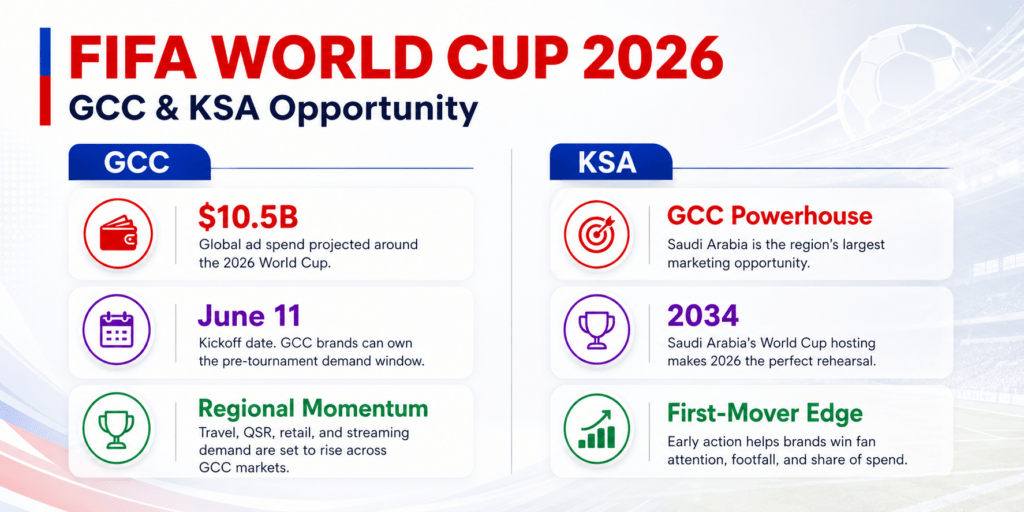
The FIFA World Cup 2026 will be the biggest edition of the tournament so far. It will be hosted across Canada, Mexico, and the United States, with 48 teams, 104 matches, and 16 host cities. The FIFA World Cup 2026 will create one of the largest live-audience moments in global sport. The question for brands is no longer simply, “Who is watching?” It is, where are they watching, how are they moving, and what moments can we activate before, during, and after the match?
49 million FIFA fans across the GCC. That’s 49 million different ways to watch the games across homes, sports cafés, mall fan zones, hotel lounges, public viewing areas, and second screens.
For GCC brands, three structural factors make this tournament uniquely valuable:
First, the expat audience is built in.
GCC populations include massive communities from participating nations. Saudi Arabia, Morocco, Tunisia, England, France, Argentina, Brazil, Egypt, Australia, the USA, and others all have cultural roots that translate directly into matchday behaviour at restaurants and public viewing locations across Dubai, Riyadh, Doha, Abu Dhabi, and Jeddah.
Second, public viewing culture is already established.
Qatar 2022 proved that football viewing in the region can operate as a structured commercial environment, not just a spontaneous crowd moment. FIFA reported that the FIFA Fan Festival at Al Bidda Park in Doha welcomed more than 1.8 million fans, with an average of 70,000 visitors per day at a 40,000-capacity venue. Dubai also hosted major fan experiences during Qatar 2022, including Expo City Dubai’s Fan City, which was designed to host up to 10,000 visitors, and the official BUDX FIFA Fan Festival at Dubai Harbour. Riyadh was also part of the international FIFA Fan Festival network through the Coca-Cola FIFA Fan Festival.
For 2026, this behaviour is already beginning to take shape again. In the UAE, Fanzone by McGettigan’s has announced a World Cup 2026 viewing destination at Bla Bla by McGettigan’s in JBR, running from June 11 to July 19, with live match coverage, entertainment, food and beverage offerings, and multiple viewing areas.
Third, GCC match timings will create new commerce windows.
With most US-hosted matches kicking off between 11 PM and 5 AM GCC time, fan behaviour skews heavily toward planned, deliberate activity:
Pre-ordered late-night QSR and food delivery
Booked tables at sports cafés and lounges
Mall or venue-based viewing with extended hours
In-home group viewing with snack and beverage runs
Pre-decided telco data plans, payment cards, and travel arrangements
This is not a stadium-economy opportunity. For GCC brands, World Cup 2026 is a mall, delivery, retail, hospitality, telco, payments, and out-of-home commerce opportunity, exactly where regional brands already compete for attention and spend.
FIFA describes the FIFA Fan Festival as a central fan destination for local communities and fans from around the world, making it a major environment for fan engagement beyond the stadium.
For marketers, this means the World Cup is not only a media event. It is a behaviour event.
The real question is not only: How do we reach football fans?
The better question is: Where are fans before, during, and after each match, and how can brands reach them when intent is highest?
What Is World Cup 2026 Marketing for GCC Brands?
World Cup 2026 marketing for GCC brands refers to campaigns built around the tournament that connect digital exposure to real-world commercial outcomes across the UAE, Saudi Arabia, Qatar, and the wider region.
It includes sports advertising, fan engagement, location-based targeting, retail promotions, QSR matchday offers, telco data and roaming campaigns, banking spend incentives, tourism activations, and crucially,measurement that proves whether media exposure drove store visits, fan zone attendance, mall footfall, or repeat commerce.
The strongest World Cup campaigns connect three things:
Audience: Who the fans are, by nationality, city, and behaviour
Location: Where they move and gather across GCC cities
Outcome: Whether they visit, engage, return, or convert
Where most commerce in the region still happens offline (Redseer estimates MENA online retail penetration at 9% in 2024, growing to 16% by 2030 within a roughly $750B retail landscape), measuring digital impact through digital metrics alone misses where the value actually lands.
The GCC World Fan Journey: Three Matchday Windows Brands Must Plan For
A match may last 90 minutes, but the GCC fan journey starts hours before kick-off and continues long after the final whistle. With most matches running late at night across the UAE/KSA/Qatar time zones, this creates three distinct, mappable campaign windows.
Matchday Stage | Fan Behaviour | Brand Opportunity | Measurement Opportunity |
Before the match | Fans move to hotels, stadiums, QSR outlets, fan zones, and viewing locations | Proximity targeting, meal offers, travel messaging, retail offers | Pre-match visitation, audience density, competitor overlap |
During the match | Fans watch, order, browse, post, check scores, and engage on second screens | Contextual creative, delivery prompts, app-based targeting, live moment messaging | Engagement, CTR, app behaviour, location-based response |
After the match | Fans leave venues and move to restaurants, hotels, malls, transit hubs, and nightlife zones | Post-match offers, conquesting, and visit-driving campaigns | Store visits, dwell time, incremental visits, exposed vs control uplift |
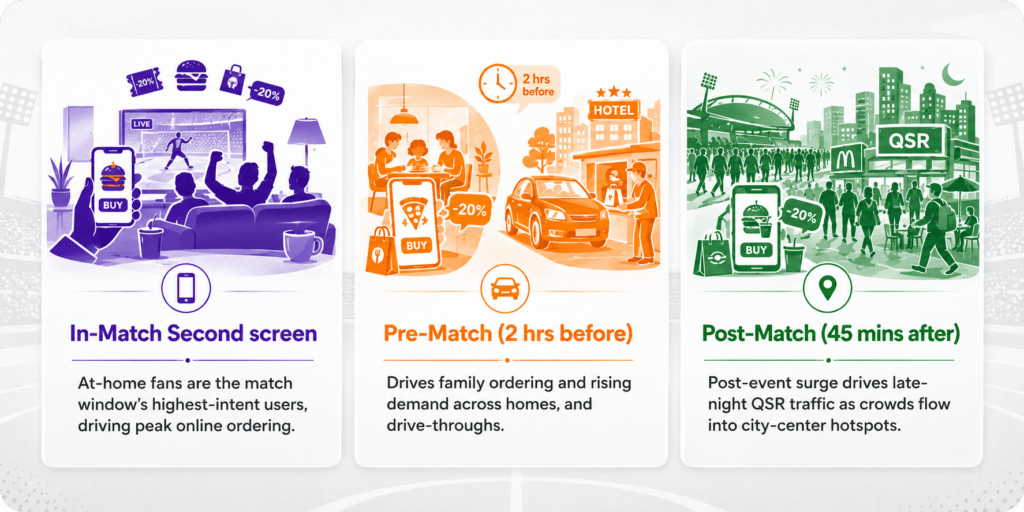
Before the Match: Where Intent Builds Across GCC Cities
The pre-match window is one of the most valuable moments for brands.
Two to four hours before kick-off, GCC fans begin moving in predictable patterns. Friends and families head to malls. Groups gather at sports bars and restaurants. Delivery apps see order spikes. Convenience stores see runs for snacks and drinks. Public viewing locations begin filling up. Ride-hailing demand rises around fan-zone-adjacent districts.
This is when intent becomes visible and addressable.
What GCC brands should map before kick-off:
Brands should identify:
Public viewing screens (Riyadh Boulevard, City Walk, La Mer, Lusail Boulevard)
Sports bar clusters (JBR, DIFC, Diplomatic Quarter, West Bay)
QSR and casual dining clusters near residential density
Hotel zones with traveling fan concentration
Convenience store and grocery clusters
Competitor restaurant and retail locations
For QSR and Food Delivery brands, the pre-match window is the highest-intent moment of the entire matchday. Fans are deciding where to eat and what to order, and creatively served between 7 PM and 9 PM GCC time, geo-fenced to residential clusters and mall districts, can capture that decision before competitors do.
For Telco brands, this is when data bundle and entertainment package offers become contextually relevant.
For retail brands, this is when sportswear, jerseys, electronics (especially TVs and audio), and matchday essentials enter the consideration window.
For Banking and Fintech brands, this is when contactless payment incentives, cashback offers on dining and delivery, and installment campaigns on big-ticket electronics align with active spending intent.
The pre-match window is not just about awareness. It is about reaching fans before they choose where to go.
During the Match: Second-Screen Behaviour Doesn’t Stop in the GCC
GCC fans during late-night matches show distinct behaviour patterns: high second-screen activity, heavy social media engagement around goals and key moments, significant in-match food delivery orders, and continued app usage for sports content, group chat reactions, and live betting (where legal).
This makes the in-match window valuable for contextual advertising, provided the creative adapts to the moment.
What changes during the match in the GCC context:
Food delivery orders peak at half-time (45+ min mark)
Group chat and social engagement spike around goals
Sports app usage becomes hyper-contextual
Public viewing audiences become dense, capturable cohorts
Creative can shift by match score, team, and time
A pre-match message should not look like a half-time message. A fan in a Dubai mall fan zone should not get the same creative as a fan ordering delivery to a Riyadh apartment. A QSR audience should not be treated like a telco audience.
This is where dynamic creative becomes a competitive advantage:
Pre-match (8 PM GCC): “Order before kick-off delivery in 30 minutes.”
Half-time: “Half-time hunger? Tap now.”
Full-time win: “Celebrate the win 20% off tonight.”
Full-time loss: “Tomorrow’s another match. Comfort food on us.”
Next day: “Ready for the next match? Pre-order now.”
The in-match window is not only about reach. It is about relevance.
After the Match: Where GCC Movement Converts
The post-match window, typically 12 AM to 3 AM GCC time during the group stage is one of the strongest measurable commercial moments in GCC sports marketing.
After full-time, fans move again: to nearby restaurants, from malls to late-night cafés, from homes to convenience stores, from public viewing areas to ride-hailing pickups. In the UAE, Saudi Arabia, and Qatar, this late-night movement creates exactly the kind of footfall window that location-intelligence-driven brands can measure and optimize against.
What GCC brands can activate after the match:
Late-night QSR and shisha café campaigns
Celebration meal and dessert offers
Ride-hailing and mobility campaigns (Careem, Uber)
Mall extended-hours retail messaging
Convenience store and 24-hour grocery offers
Winner versus loser creative messaging (separated by team)
Competitor conquesting around rival restaurants and venues
Next-match retargeting to confirmed matchday audiences
The right measurement question is no longer “How many people saw the ad?” It is:
Did exposed audiences visit a store within 4 hours of full-time?
Did fan-zone audiences convert better than residential audiences?
Which GCC cities and zones produced the highest incremental footfall?
Did competitor locations attract our exposed audience?
What was our cost per incremental store visit?
This is the difference between campaign reporting and campaign intelligence and it is where GCC brands using offline attribution will pull ahead of those still measuring on impressions and CTR alone.
Why Stadium-Centric Planning Doesn’t Work for GCC Brands
The biggest mistake GCC brands will make in 2026 is treating World Cup marketing as a sports media buy. Stadiums in North America are irrelevant to your audience. What matters is the commercial environment your fans move through across GCC cities.
A typical Dubai matchday journey may start at home, move to a mall fan zone, shift to a restaurant cluster after the match, end at a convenience store or shisha lounge. A Riyadh fan may move from a residential compound to Riyadh Boulevard to a late-night dining strip. A Doha fan may travel from Pearl Qatar to Lusail to a West Bay restaurant.
These are mappable, repeatable patterns. They are also completely missed by media plans that target only “football fans” through interest-based audience segments on social platforms.
What GCC brands should actually map:
Public viewing locations (city-by-city)
Restaurant clusters near residential density
Sports bar and shisha lounge clusters
Hotel concentrations (for traveling fans within GCC)
Airport corridors (for inter-GCC travel)
Mall and retail districts
Tourist attractions during off-match windows
Convenience and grocery store clusters
Team-nationality community areas (Brazilian, Argentinian, Moroccan, French, English expat clusters)
Post-match late-night districts
Direct competitor locations
The most valuable audience may not be near a screen at all, it may be the audience deciding where to go after the match.
That decision is influenced by ads, offers, and proximity. Map it.
How Location Intelligence Changes World Cup Marketing in the GCC
Location intelligence is the difference between guessing where your audience is and knowing it. For GCC brands during World Cup 2026, it answers questions that interest-based targeting and standard programmatic cannot:
Which Dubai malls gain the most pre-match density on weekend match nights?
Which Riyadh districts produce the highest post-match footfall to restaurants?
Which Doha residential clusters generate the most delivery orders during half-time?
How do Brazilian expat communities in Dubai differ in matchday movement from Argentinian communities?
Which competitor QSR locations attract our exposed audiences after exposure?
Which fan zones drive incremental visits versus natural foot traffic?
Which media zones deserve higher investment for matchdays involving specific teams?
GCC sports audiences are not static. They move by time of day, match schedule, team affinity, city layout, transit access, viewing preference, and social context. A football fan at 6 PM near a Dubai mall is behaviourally different from a fan at 1 AM heading to a late-night restaurant. A traveling Saudi visitor in Doha behaves differently from a local resident in Riyadh.
The role of location intelligence is to separate these behaviours and let brands activate against them with precision, and then measure whether activation drove movement.
GCC Category Playbooks for World Cup 2026
QSR and Food Delivery Brands in the GCC
Before the Intent to Watch, Comes the Intent to Eat
The journey is sequential and predictable. Craving hits as fans check menus before kickoff. Order placed as food is confirmed and on its way. Food arrives right on time for the match. Match ready, fueled, settled, ready to watch.
The opportunity: 1 in 3 GCC consumers plan to order food during the World Cup. 80% of those orders are for groups of 2-5. Late-night match timing aligns with peak delivery and casual dining behaviour.
Campaign opportunities:
Pre-kick-off delivery offers geo-fenced to residential clusters
Half-time prompt campaigns through delivery apps
Post-match late-night dining and dessert offers
Mall fan zone proximity targeting via DOOH and mobile
Conquering the direct competitor QSR locations
Dynamic offers tied to match outcomes (win/loss creative)
Family-meal bundles for weekend matches
Sports bar and lounge area campaigns
Measurement priorities:
Store visits within a 2-4 hour post-match window
Delivery order lift versus control
Incremental visits to physical locations
Dwell time at dine-in locations
Cost per incremental visit
Competitor visitation overlap
Strategic question: Which GCC cities and matchday windows produce the highest incremental restaurant visits and delivery orders for your brand?
Retail and Mall Brands in the GCC
Retail brands across the UAE, Saudi Arabia, and Qatar should not treat World Cup 2026 as only a sports merchandise opportunity. It is also a family entertainment, electronics, fashion, and social-shopping moment, particularly during weekend matches when venues extend hours for Social Viewers.
Campaign opportunities:
Football merchandise and team kit campaigns
TV, audio, and home electronics promotions tied to matchday
Mall-based viewing experience promotion
Family entertainment offers during day-match windows
Tourist shopper targeting (inter-GCC travelers)
Post-match retail extended-hours campaigns
Team-country apparel for expat audiences
Casual dining and F&B within malls
Measurement priorities:
Mall visitation lift versus baseline weekends
Store visits within mall environments
Dwell time during fan-zone events
New versus returning visitor mix
Cross-mall visitation patterns
Competitor mall overlap
Strategic question: Which GCC mall environments attract the highest fan footfall before, during, and after key matches and how does that translate to your specific stores?
Travel and Tourism Brands in the GCC
While most GCC fans will watch from local fan zones and homes, the tournament still creates significant inter-GCC and outbound travel, particularly the 235% and 160% booking surges in the UAE and KSA. Tourism boards, airlines, hotels, and destination brands can activate against confirmed Traveler audiences.
Campaign opportunities:
Inter-GCC weekend travel packages tied to fan-zone destinations
Hotel cluster campaigns near major public viewing zones
Destination guides featuring matchday experiences
Day-trip packages around weekend matches
Cross-city traveler segmentation
Post-match attraction offers
Measurement priorities:
Cross-city travel patterns
Hotel district movement
Tourist attraction visits during off-match windows
Dwell time at destinations
Repeat city visitation
Strategic question: How can your destination convert World Cup-related interest into broader inter-GCC tourism?
Telco Brands in the GCC
UAE telcos (du, Etisalat), Saudi telcos (STC, Mobily, Zain KSA), Qatari (Ooredoo, Vodafone Qatar) will see significant data and entertainment package demand during World Cup 2026. Streaming demand, group viewing connectivity, and matchday data spikes all create commercial moments.
Campaign opportunities:
Matchday data bundle promotions
Roaming and eSIM offers targeted to verified Travelers from booking through arrival
Streaming and entertainment package campaigns
Group viewing connectivity offers
App-usage-based targeting in fan-dense zones
Public viewing area sponsorship and connectivity messaging
Roaming offers for inter-GCC travel
Family and shared-data plan campaigns
Measurement priorities:
Offer engagement and conversion
Reach across high-density fan zones
App behaviour signals
Movement between residential, mall, and viewing zones
Retargeting response on confirmed fan audiences
Strategic question: Where across your GCC market do connectivity and entertainment needs spike during matchday windows?
Banking and Fintech Brands in the GCC
UAE banks (Emirates NBD, FAB, ADCB), Saudi banks (Al Rajhi, SNB, Riyadh Bank), Qatari banks (QNB, Doha Bank), and regional fintechs (Tabby, Tamara, Postpay) can connect spending offers to the real-world environments where fan spending intent is already active.
Campaign opportunities:
Cashback on matchday dining and delivery
Installment offers on TVs and home electronics ahead of the tournament
Contactless payment incentives at fan zones
Travel card offers for inter-GCC travel
Co-branded offers with QSR and retail partners
BNPL campaigns on big-ticket matchday purchases
Measurement priorities:
Visit the lift around the offer zones
Retail and dining footfall
Repeat spending behaviour
Movement to commercial commerce areas
Cross-merchant behaviour
Strategic question: Where and when do GCC fans spend most around matchday, and how can your card or app become the default payment method?
Automotive and Mobility Brands in the GCC
Ride-hailing platforms (Careem, Uber), car rental brands, automotive dealers, and mobility apps will see significant demand reshape during late-night match windows. Post-match transit, weekend travel, and day-of test-drive activity all create category opportunities.
Match moments create high-attention, high-emotion environments where automotive brands can compete for share of mind ahead of Q4 launch cycles.
The audiences worth identifying: high-attention viewers, social and mobile-first fans actively engaging across locations and devices, and experience-driven segments who will be in-market for premium vehicle decisions in late 2026.
Campaign opportunities:
Ride-hailing partnership promotions for post-match windows
Late-night surge-discount campaigns
Test-drive incentives during weekend day-match windows
Car rental promotions for inter-GCC travel
Parking offers near fan zones
Route and corridor-based DOOH messaging
Measurement priorities:
Movement corridor density
Ride-hailing demand lift versus baseline
Test-drive visitation
Post-match mobility patterns
Travel-time catchment performance
Strategic question: Which mobility corridors create the most demand around matchday in your GCC market, and how do you capture it?
How MEmob+ Helps GCC Brands Plan, Activate, and Measure World Cup 2026 Campaigns
MEmob+ has been preparing for FIFA 2026 since Qatar 2022. Real-world movement tracking across MENA through every major football tournament, Premier League, LaLiga, Champions League, Europa League, Bundesliga, Serie A, AFCON, Copa America, Asian Cup, Saudi Pro League, and more, has built the behavioural foundation now ready for activation.
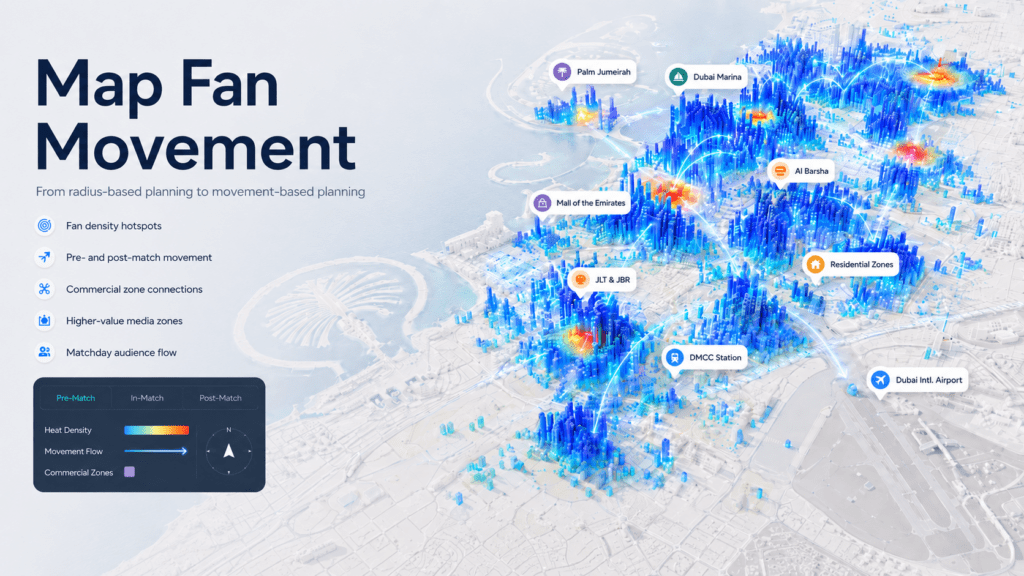
GeoSense: Map GCC Fan Movement
GeoSense visualises fan movement across stadiums, fan zones, airports, hotels, malls, QSR clusters, transit hubs, and city corridors throughout the UAE, Saudi Arabia, Qatar, Kuwait, Bahrain, and Oman. It moves brands from radius-based planning to movement-based planning, understanding where fan density is building, which locations matter at which matchday stage, and which areas justify higher media investment.
It helps brands understand:
Where fan density is building
Which locations matter before and after matches
How audiences move between commercial zones
Which areas deserve higher media investment
Which movement patterns create campaign opportunities
For World Cup 2026, GeoSense helps brands move from radius-based planning to movement-based planning.
AllPings: Build Real-World Audience Segments
AllPings builds audience segments using mobility signals, location intelligence, app behaviour, and contextual data. For World Cup 2026, GCC-specific segments include:
Fan-Zone Visitors
Mall-Based Viewers
Sports App Users
QSRs and Delivery Audiences
Hotel-Area Travelers
Expat Communities By Nationality
Residential Cluster Audiences By City
Competitor Store Visitors
Public Viewing Audiences
This moves brands beyond generic “football fans” interest targeting into segments built on real-world GCC behaviour.
Excelate: Activate Across Digital Channels
Excelate DSP activates World Cup audiences programmatically across mobile, display, video, rich media, CTV, and DOOH, natively integrated for the GCC’s mall, retail, and outdoor inventory landscape.
Brands reach fans based on:
City
Location
Matchday stage
Audience segment
App behaviour
Commercial intent
Proximity to commercially relevant zones, all without dependence on cookies or fragile cross-platform identity.
This makes activation more precise than generic football-interest targeting.
Blueprint: Personalise Creative by Match Context
Blueprint adapts creatives based on match context, location, time of day, language (Arabic and English), and audience behaviour.
Pre-match QSR audiences see different messaging from half-time delivery audiences.
Winning-team fans see different post-match creative from losing-team fans.
Mall-based audiences see different creative from at-home audiences.
This is where GCC matchday relevance becomes a competitive moat.
Examples include:
“Fuel up before kick-off” for pre-match QSR audiences
“Your match snack is one tap away” during half-time
“Celebrate nearby” after a win
“Stay connected across every host city” for telco audiences
“Get match-ready before the next game” for retail audiences
Dynamic creative matters because fan intent changes throughout the day. The message should change with it.
Stretch: Measure Real-World Impact
Stretch measures whether exposed GCC audiences actually visited physical locations after seeing a campaign
For World Cup 2026, brands can measure:
Store visits
Restaurant visits
Mall visits
Fan zone visits
Dwell time
Visit frequency
Incremental visits
Exposed vs control group uplift
Cost per incremental visit
Competitor visitation overlap
This is the measurement layer that turns matchday media into proven commercial impact.
How GCC Brands Should Measure World Cup 2026 Campaign Performance
World Cup campaigns will generate huge attention. Attention is not enough. GCC brands need a measurement framework that connects digital exposure to physical commerce.
Metric | What It Shows |
Reach | How many people were exposed |
CTR | Whether the ad generated immediate interest |
Engagement rate | Whether users interacted with the creative |
Viewability | Whether ads had the chance to be seen |
Store visits | Whether audiences visited physical locations |
Dwell time | How long did audiences stay |
Visit frequency | Whether audiences returned |
Incremental visits | Additional visits driven by the campaign |
Cost per incremental visit | Efficiency of real-world visitation |
Exposed vs control uplift | Whether exposed users behaved differently |
Competitor overlap | Whether audiences also visited competitors |
The best GCC World Cup 2026 campaigns will not stop at digital metrics. They will prove whether the media created the movement.
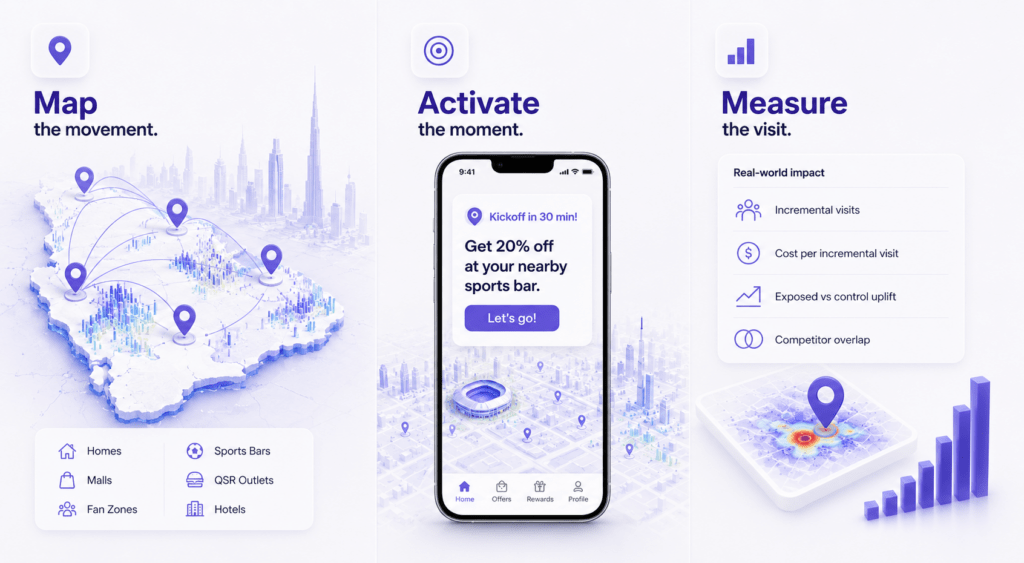
MEmob+ Methodology for World Cup 2026 Campaign Planning
A strong campaign follows a structured planning approach.
Map the environment: Identify fanzone by McGettigan’s, public viewing screens such as Bla Bla in JBR, QSR clusters, restaurant districts, residential clusters, hotel zones, airport corridors, and competitor locations across each GCC city you serve.
Define the audience: Separate local fans, expat communities by nationality, mall-based viewers, at-home delivery audiences, sports app users, and competitor audiences.
Segment by timing: Build campaign logic around pre-match (-4 to -1 hour), in-match (kick-off to full-time), post-match (full-time to +4 hours), and next-day retargeting windows, adjusted for GCC time zones.
Activate by intent: Use programmatic media to reach audiences based on where they are, what they are doing, and which match-day moment they are in.
Personalize creative: Adapt by location, timing, audience type, match outcome, and language.
Measure real-world outcomes: Compare exposed and matched control groups to quantify visit uplift, dwell time, incremental footfall, and cost per incremental visit.
This approach helps brand move from campaign planning to movement intelligence.
The Future of Sports Marketing Is Movement-Led
World Cup 2026 will reward GCC brands that understand fan behaviour beyond the screen. The brands that win in this region will not be the ones that buy the most matchday media. They will be the ones who understand how UAE, Saudi, and Qatari fans move through cities, where intent builds across matchday windows, and which real-world moments create commercial impact.
The match may last 90 minutes. The marketing opportunity starts hours before kick-off and continues long after the final whistle.
The GCC audience is already moving. The brands that win won’t be louder. They will be more precise.
Frequently Asked Questions (FAQ’s)
How many football fans are there in the GCC for FIFA 2026?
There are approximately 49 million FIFA fans across the GCC, distributed across the UAE, Saudi Arabia, Qatar, Kuwait, Bahrain, and Oman. Behavioural data tracked across MENA since the Qatar 2022 World Cup segments these fans into high-value groups.
What is World Cup 2026 marketing for GCC brands?
World Cup 2026 marketing for GCC brands refers to campaigns built around the FIFA World Cup that connect digital exposure to real-world commercial outcomes across the UAE, Saudi Arabia, Qatar, and the wider region. It includes location-based targeting, programmatic activation, dynamic creative, and footfall attribution built around malls, the UAE fanzone by McGettigan’s, restaurants, public viewing locations, and matchday consumer behaviour.
When should GCC brands start planning their World Cup 2026 campaigns?
GCC brands should be planning now. The tournament runs from June 11 to July 19, 2026, and the strongest campaigns require 8-12 weeks of pre-launch work to map fan movement, build audience segments, set up measurement frameworks, and produce dynamic creative. Brands waiting until May 2026 will miss the planning window.
How can UAE and Saudi brands reach football fans during the World Cup?
Through location intelligence, programmatic advertising is activated by city and matchday window, mobile and DOOH targeting at malls, fanzone by McGettigan’s, contextual creative that adapts to match timing, and audience segments built on real-world GCC behaviour rather than generic interest data. The strongest opportunities are around malls, restaurants, residential clusters, public viewing zones, and post-match late-night commerce.
How can GCC QSR brands use fan movement data?
GCC QSR brands can use fan movement data to identify when and where fans gather pre-match, time delivery offers to half-time, target post-match late-night dining locations, and measure incremental store visits driven by matchday campaigns. Late-night match timing in the GCC creates particularly strong delivery and dine-in opportunities.
How is footfall attribution measured for World Cup campaigns in the GCC?
Footfall attribution measures whether people exposed to a campaign visited a physical location afterward. For GCC World Cup campaigns, this includes visits to restaurants, malls, the fanzone by McGettigan’s, retail stores, hotels, or convenience stores. It compares exposed audiences against matched control groups to isolate the incremental visits caused by the campaign, not just visits that would have happened anyway.
What is the role of location intelligence in GCC sports marketing?
Location intelligence helps GCC brands understand where audiences are, how they move across UAE, Saudi, and Qatari cities, which physical environments matter at which moment, and how media exposure connects to real-world behaviour. It is what separates brands that buy matchday media from brands that drive match-day commerce.
Why is the GCC fan journey different from other markets?
The GCC fan journey is shaped by late-night match timing (most US-hosted matches kick off between 9 PM and 4 AM GCC time), mall and public viewing infrastructure, large expat communities from participating nations, predominantly offline commerce, and culturally specific dining and gathering patterns. These factors create commercial windows that don’t exist in other markets and require different planning.
Plan Your GCC World Cup 2026 Strategy with MEmob+
The GCC audience is already moving. MEmob+ helps brands across the UAE, Saudi Arabia, Qatar, and the wider region map fan movement, activate the four high-value FIFA 2026 segments, and measure real-world impact across every match-day window.