

Table of Contents
ToggleWhy Modern Marketing Needs More Than Platform Metrics
Digital advertising has never been bigger, faster, or more fragmented. Campaigns now run simultaneously across Meta, TikTok, Google, programmatic DSPs, retail media networks, publishers, connected TV, and emerging commerce platforms. Budgets have expanded as brands compete for attention across dozens of environments, each with its own algorithms, reporting logic, and measurement constraints.
On paper, marketing has never been more measurable.
And yet, despite all of this sophistication, many CMOs and marketing leaders still struggle to answer the most fundamental business question:
What actually worked?
- Not what earned clicks.
- Not what generated impressions.
- Not what a dashboard credited to itself.
But what truly drove incremental customers, real-world outcomes, and measurable business impact.
This is the accountability gap at the center of modern advertising. Marketing is everywhere but clarity is missing.
The reason is structural: most performance reporting still happens inside closed ecosystems, often referred to as walled gardens. These platforms control ad delivery, user-level data access, and measurement within their own environments, making cross-channel truth difficult to observe end-to-end. LiveRamp describes walled gardens as closed platforms that limit interoperability and independent measurement across the broader ecosystem.
(Source: LiveRamp, “Walled Gardens Advertising Explained”)
In response, a new layer is increasingly emerging in enterprise marketing stacks: an independent way to observe exposure across platforms, detect overlap, and connect delivery to outcomes. Stretch fits this role as a lightweight cross-channel measurement layer designed to unify performance context across ecosystems rather than inside one platform’s walls.
For modern marketers, the challenge is no longer running campaigns. The challenge is building an independent understanding of outcomes across an ecosystem that was never designed to share one unified truth.
The Attribution Crisis: Why Digital Marketing Still Feels Like Guessing
For the past decade, advertising platforms have trained marketers to optimize around what they can easily report:
- Click-through rates
- Video views
- Reach
- Frequency
- Cost per impression
- Engagement metrics
These indicators are not meaningless. They are operationally useful for channel-level optimization. But they are incomplete.
They primarily tell you what happened inside one platform, not what happened across the entire customer journey.
The modern consumer does not live in one channel.
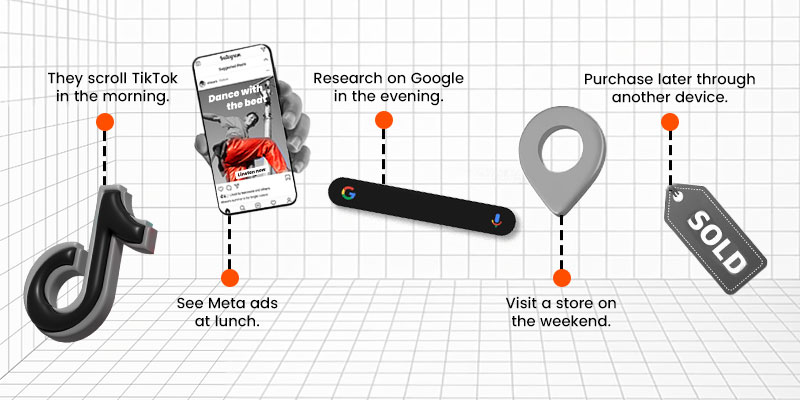
Yet most measurement systems still behave as if the journey happens in a single, isolated environment.
That mismatch is the attribution crisis.
One practical response is the rise of neutral, cross-channel observability, where exposure signals can be viewed consistently across multiple environments and translated into incremental business outcomes. Stretch is built around this tag-based approach, consolidating results into a unified view rather than leaving performance trapped in silos.
Why This Matters for CMOs
For CMOs, attribution is not an analytics problem. It is a strategic governance problem.
When performance measurement is fragmented:
- Budget allocation becomes guesswork
- Incrementality is unclear
- Platforms over-credit themselves
- Offline outcomes remain disconnected
- Executive confidence in marketing declines
Marketing leaders increasingly face CFO-level scrutiny, where “engagement” is no longer an acceptable proxy for business impact.
Industry bodies such as the IAB have responded by emphasizing incrementality measurement approaches, especially in commerce and retail media, because marketers must understand what outcomes would not have occurred without advertising.
(Source: IAB, “Guidelines for Incremental Measurement in Commerce Media”).
The shift is clear: the future of measurement is not attribution optics. It is an incremental truth.
The Real Problem: Fragmentation and the Limits of Platform Reporting
Advertising today is not one ecosystem. It is dozens of disconnected ecosystems:
- Social platforms
- DSPs
- Direct publishers
- Mobile ad networks
- Retail media networks
- Offline retail environments
Each platform reports success through its own lens, its own incentives, and its own limitations.
This creates a broken measurement reality:
- You cannot see the audience overlap clearly
- You cannot confirm incremental reach with confidence
- You cannot connect exposure to offline behavior consistently
- You cannot enrich audiences beyond basic demographics
- You cannot retarget seamlessly across platforms
Marketing becomes a game of partial truths.
The Walled Garden Constraint
The concept of walled gardens is central here. Adjust defines walled gardens as closed advertising ecosystems where user-level data is not shared openly, limiting cross-platform attribution and independent measurement. (Source: Adjust Glossary, “Walled Garden”).
This does not mean platforms are deceptive; it means they are structurally bound. Meta can measure Meta. TikTok can measure TikTok. Google can measure Google.
None of them can measure the ecosystem.
That is why cross-channel measurement layers matter: they complement platform dashboards by revealing overlap, incrementality, and ecosystem-wide outcomes precisely the gap Stretch was designed to address.
Why Privacy and Signal Loss Are Accelerating the Crisis
The measurement environment is also changing rapidly due to privacy expectations, regulations, and signal degradation.
Third-party cookies, long used for cross-site tracking, are increasingly viewed as incompatible with modern privacy standards. The World Wide Web Consortium (W3C) has argued that third-party cookies undermine user privacy and should be phased out.
(Source: W3C Blog, “Third-party cookies have got to go”).
At the same time, the advertising industry has experienced ongoing uncertainty around cookie deprecation timelines and Privacy Sandbox direction, with major public reporting documenting shifts in approach.
(Source: Reuters, April 2025 coverage of Google cookie policy direction).
In response, platforms and privacy-safe environments increasingly enforce aggregation thresholds and privacy checks. Google Ads Data Hub, for example, applies privacy rules that restrict reporting below minimum thresholds.
(Source: Google Ads Data Hub Privacy Checks Documentation).
For marketers, the implication is profound:
The era of easy user-level attribution is ending.
The future belongs to marketers who can build measurement systems that remain valid in a privacy-first, fragmented ecosystem, favoring aggregated truth, cross-channel governance, and outcome-based accountability.
The Hidden Budget Leak No One Talks About: Audience Duplication
One of the most expensive inefficiencies in digital advertising is also one of the least visible:
Cross-platform audience duplication.
Every major platform reports its reach. Every dashboard tells you how many users you “hit.”
But very few tell you:
How many of those users were the same people you already reached somewhere else.
That is the duplication blind spot.
- If Meta says you reached 2 million users
- And TikTok says you reached 1.5 million users
- And DV360 says you reached 1 million users
Marketers often assume they reached 4.5 million unique people.
In reality, a significant percentage overlaps.
Stretch revealed 28% duplication between TikTok and Meta, indicating that nearly a third of “reach” was repeated exposure rather than incremental expansion.
Repeated exposure is not inherently bad. Frequency builds recall.
But uncontrolled duplication is wasted on masquerading as performance.
Why Duplication Matters More in GCC Markets
In GCC markets such as the UAE and Saudi Arabia, media consumption is highly mobile-first, and urban audiences are concentrated around key retail and lifestyle hubs.
Brands often compete aggressively for the same premium segments:
- Mall catchments
- Luxury shoppers
- High-frequency QSR visitors
- Tech-savvy urban professionals
Without cross-channel visibility into overlap, marketers frequently overpay to reach the same high-value consumers repeatedly across platforms.
Incremental reach becomes the true strategic KPI.
The Need for an Independent Measurement Layer
This is why modern marketing increasingly requires what can be described as:
- A neutral measurement fabric
- A cross-channel attribution spine
- An ecosystem-wide exposure layer
- A unified truth system beyond platform silos
Not to replace platforms but to connect them.
Stretch describes a lightweight tagging approach placed on ad creatives across channels that tracks impressions and clicks, identifies duplication, links exposure to offline behavior, enriches audiences, and consolidates results into one unified dashboard.
The strategic point is simple:
Marketing performance cannot be understood inside silos anymore.
CMOs need measurement systems that reflect how consumers actually move: across platforms, across devices, and into the physical world.
Competitive Context
Enterprise marketers are not short on tools. They are surrounded by dashboards.
But most solutions solve only partial layers:
- Platforms provide siloed reporting
- Mobile attribution platforms (AppsFlyer, Adjust) focus on app installs
- Identity platforms (LiveRamp) focus on onboarding
- Panels (Nielsen, Kantar) provide modeled benchmarks
Cross-channel measurement layers such as Stretch fill the missing space: duplication visibility, unified exposure truth, offline attribution, and enrichment across ecosystems.
Incrementality, Audience Duplication, and the Search for Cross-Channel Truth
Are We Driving Incremental Growth, or Paying Repeatedly for the Same Outcomes?
This is the central measurement challenge of modern advertising.
Marketing has entered an era where the issue is no longer whether brands can reach audiences. Reach is abundant. Media is everywhere.
The harder question is whether brands are reaching audiences incrementally, efficiently, and with measurable business impact across platforms.
That is why the industry is shifting away from surface performance metrics and toward a deeper concept: Incrementality.
Incrementality is becoming the defining standard of marketing accountability, not just for analysts, but for CFOs, boards, and executive leadership.
What Incrementality Actually Means (And Why CMOs Care)
Incrementality is one of the most important and most misunderstood ideas in marketing measurement.
At its core, incrementality asks:
What outcomes happened because of advertising that would not have happened otherwise?
Not what was correlated with exposure.
Not what a platform attributed to itself.
But what was truly incremental.
Industry bodies such as the IAB have emphasized incrementality as a critical measurement priority in commerce and retail media, recommending structured approaches such as experiments, counterfactual methods, and econometric models.
(Source: IAB, “Guidelines for Incremental Measurement in Commerce Media”).
For CMOs, incrementality is the language of credibility.
Because when marketing budgets rise, executive teams do not ask:
“How many impressions did we buy?”
They ask:
- Did we acquire new customers?
- Did we expand penetration?
- Did we drive footfall lift?
- Did we take share from competitors?
- Did we generate outcomes that justify spending?
Incrementality is what separates performance optics from business truth.
Why Platform Attribution Often Overstates Impact
Most platforms operate with attribution models that are inherently limited by their ecosystem boundaries.
This is not necessarily intentional bias. It is structural.
Meta can observe:
- Meta impressions
- Meta clicks
- Meta conversions
TikTok can observe:
- TikTok exposure
- TikTok engagement
Google can observe:
- Search intent
- YouTube exposure
- Google conversion paths
But no single platform can observe the full ecosystem.
This is why walled gardens create measurement fragmentation.
Adjust defines walled gardens as closed ecosystems where data access is restricted, limiting cross-platform attribution and independent measurement.
(Source: Adjust Glossary, “Walled Garden”)
The result is a common enterprise problem:
Each platform claims credit for outcomes shaped by multiple exposures.
A customer may see:
- TikTok ad on Monday
- Meta ad on Tuesday
- Google search ad on Thursday
- Visit a store on Saturday
“Who gets credit?”
Each platform tells a partial story, often an inflated one.
This is why CMOs increasingly require independent measurement approaches beyond platform-native reporting.
Cross-channel layers like Stretch exist precisely to provide ecosystem-wide exposure context: identifying overlap, isolating incremental reach, and connecting delivery to outcomes across channels.
Audience Duplication: The Hidden Enemy of Incremental Reach
One of the most expensive barriers to incrementality is cross-platform duplication.
Most marketers optimize for “reach.”
But reach without uniqueness is misleading.
Audience duplication occurs when the same users are reached across multiple platforms, inflating reported reach and wasting budget.
Every platform reports its own reach.
Few report overlap.
This creates the illusion of scale:
- Meta reports millions reached
- TikTok reports millions reached
- DSPs report millions reached
But a significant portion is the same audience repeated. That means nearly a third of what appeared to be “new reach” was actually recycled reach.
Why This Matters Economically
Duplication is not just a measurement issue.
It is a budget efficiency issue.
If 30–50% of the exposure is overlapping, then:
- Unique reach is lower than expected
- CPM efficiency is overstated
- Incremental customer acquisition is weaker
- Spend concentrates on already-exposed users
- Marginal returns decline faster
CMOs often experience this as a “performance plateau.”
In reality, it is often duplication saturation.
The ability to see overlap while campaigns are live is what allows marketers to reallocate spend toward incremental audiences instead of paying twice for the same exposure.
The CMO Framework: Reach vs Frequency vs Waste
A sophisticated marketing leader does not assume duplication is always bad.
The real question is:
Is repetition intentional or accidental?
There are three exposure states:
- Incremental Reach
New users reached for the first time. - Strategic Frequency
Controlled repetition that builds recall or accelerates conversion. - Uncontrolled Duplication
Accidental overlap across platforms that wastes spend.
Cross-channel measurement is what allows marketers to separate:
Productive frequency From Unproductive duplication.
Without visibility, repetition becomes a vicious circle of marketing effectiveness.
The Shift from Channel Optimization to Ecosystem Optimization
Traditional media optimization asks:
- Which platform has the best CTR?
- Which channel has the lowest CPA?
- Which creative drives engagement?
Modern marketing optimization asks for something harder:
- Which channel adds incremental reach?
- Which platform delivers new customers, not recycled ones?
- Which exposures actually move offline behavior?
- Where is spend redundant across the ecosystem?
This is the difference between:
Channel performance and Ecosystem incrementality
CMOs are no longer managing channels.
They are managing cross-channel systems.
Stretch positions itself within this ecosystem lens by helping advertisers identify overlap, unify exposure signals, and connect outcomes beyond platform walls.
Competitive Context: Where Stretch Fits vs Other Solutions
Enterprise marketers are surrounded by measurement tools, but most solve partial layers:
- Mobile Attribution Platforms (AppsFlyer, Adjust): Strong for installs and app events, less designed for cross-platform overlap and offline visitation.
- Identity Platforms (LiveRamp): Strong for onboarding and identity resolution, not built for real-time duplication visibility.
- Panel Measurement (Nielsen, Kantar): Strong for benchmarking and modeled brand impact, not campaign-level exposure truth.
- Platform Dashboards (Meta/TikTok/Google): Strong for in-platform metrics, structurally limited by walled garden boundaries.
Cross-channel measurement layers like Stretch fill the missing space: unified exposure, duplication detection, offline attribution, enrichment, and activation across ecosystems.
Offline Attribution for Retail, QSR, and GCC Markets: Measuring Real-World Impact
If incrementality is the strategic question modern CMOs must answer, then offline attribution is often the strongest proof.
Because for many industries, especially in retail-heavy economies, the most valuable outcomes do not happen on a screen.
They happen in the physical world:
- In stores
- In malls
- In dealerships
- In restaurants
- In branches
- In real customer movement and purchase behavior
Nowhere is this more true than in the GCC.
The UAE, Saudi Arabia, Qatar, and the wider MENA region represent one of the most digitally connected yet physically commerce-driven markets in the world. Consumers are mobile-first, social-first, and highly engaged online; yet purchasing remains deeply offline across major categories.
For marketing leaders in the GCC, the question is not whether digital advertising works.
The question is:
Can we prove it drove footfall, revenue, and incremental business outcomes?
That is where offline attribution becomes essential.
Why Offline Attribution Matters More in GCC Than in E-Commerce-First Markets
In North America and parts of Europe, digital measurement has historically been anchored in e-commerce conversion paths:
Clicks – Carts – Purchases – Attribution Models
But the GCC is structurally different.
The GCC Retail Reality
Retail and QSR growth in the GCC is shaped by:
- Mall-centric shopping culture
- Luxury retail expansion
- Hypermarket dominance
- Offline-first QSR behavior
- High mobility across dense urban hubs
- Tourism-driven commerce in key cities
- Physical experience as a conversion driver
Even when discovery begins online, conversion often ends offline.
A consumer may:
- See a TikTok campaign for a new beauty brand
- Save the product mentally
- Visit the Dubai Mall days later
- Purchase in-store
- Never click an ad
Traditional platform metrics miss that entirely.
Offline attribution is how marketing connects digital exposure to physical commerce.
The Core Challenge: Digital Platforms Were Not Built for Store Truth
Most platform-native reporting optimizes around what platforms can easily observe:
- Clicks
- Engagement
- Video views
- On-platform conversions
But store visits, footfall lift, and competitor switching are not native platform KPIs.
This creates a measurement gap:
Digital advertising influences offline behavior, but platforms rarely measure it end-to-end.
This is why retail marketers often fall back on proxy metrics:
- Awareness campaigns judged by CPM
- Retail campaigns judged by CTR
- Store success inferred through surveys
- Offline impact treated as anecdotal
The result is a disconnect between marketing and business reality.
Offline attribution closes that gap.
What Offline Attribution Actually Measures
Offline attribution answers questions that matter to CMOs, retail directors, and CFOs:
- Who was exposed to an ad campaign?
- Which exposed audiences later visited a store?
- What is the cost per store visit?
- Did advertising increase incremental footfall?
- Did we shift customers away from competitors?
- Which regions or catchments performed best?
Offline attribution transforms digital advertising into measurable retail outcomes. Instead of optimizing toward clicks, marketers can optimize toward verified visits.
The Retail Attribution Framework CMOs Should Use
To make offline attribution credible at an executive level, it must be structured around business-grade KPIs.
Here is the framework enterprise retail leaders increasingly adopt:
Exposure – Visit Matching
The foundation is connecting ad exposure (impression or click) to subsequent store visits.
Stretch’s approach is based on tracking cross-channel exposure and matching it to real-world visitation behavior.
This creates a consistent view of how advertising influences physical movement.
Incremental Footfall Lift
The key question is not “how many visits occurred.”
It is: How many visits happened because of advertising?
This is where incrementality intersects with offline attribution.
Without incrementality, attribution becomes correlation. With incrementality, attribution becomes business truth.
Cost per Verified Visit (CPV)
Retail marketers increasingly report:
Cost per store visit instead of Cost per click. Because visits are closer to revenue. This aligns marketing reporting with business outcomes.
Trade-Area and Catchment Performance
In GCC retail, geography matters.
Brands need to understand which:
- malls
- neighborhoods
- cities
- regions
are driving incremental footfall.
Offline attribution enables store-level and catchment-level ROI visibility.
Competitor Conquesting
Retail growth is often about stealing share.
Offline attribution enables measurement of:
- visitors who previously frequented competitor locations
- shifts in footfall behavior post-campaign
Case Study: QSR Footfall Attribution as the Gold Standard
Quick-service restaurants represent one of the clearest offline attribution use cases.
QSR brands invest heavily across:
- Meta
- TikTok
- Programmatic
- Location-based targeting
But the true KPI is simple:
Did ads drive people into stores?
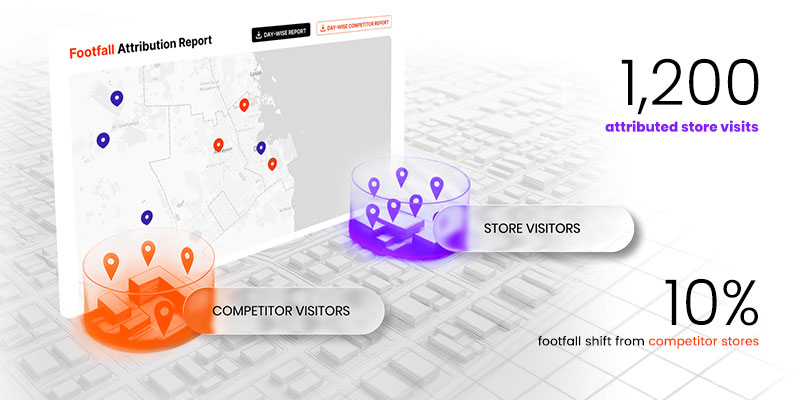
Stretch’s QSR case study demonstrates this exposure-to-footfall loop:
- Exposure tracked across TikTok, Meta, and DV360
- Store visits matched post-exposure
- Competitive switching observed
This is why offline attribution is so powerful, it turns advertising into measurable physical ROI.
Audience Duplication Meets Offline Attribution
Offline attribution becomes even more valuable when paired with cross-channel duplication visibility.
Because retail brands rarely advertise in one channel.
They advertise everywhere:
- TikTok for discovery
- Meta for storytelling
- DSPs for scale
- Snap for Saudi youth segments
- Retail media for conversion
Each platform reports reach. But without overlap measurement, marketers often overpay for repeated exposure.
Stretch highlights this duplication clearly:
Stretch identified 28% duplication between TikTok and Meta.
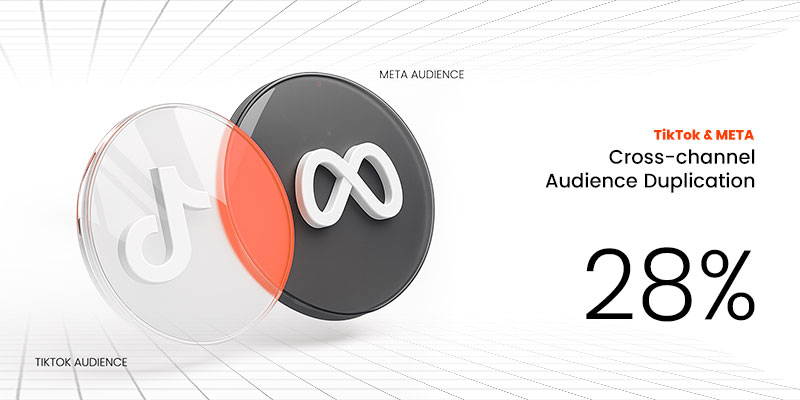
The retail implication is direct:
If exposure is duplicated, footfall attribution may appear inflated. Cross-channel truth ensures offline ROI is incremental, not redundant.
Why Offline Attribution Is the New CFO Language
CMOs increasingly operate under financial scrutiny.
Boards and CFOs do not want:
- impressions
- engagement
- vanity reach
They want:
- incremental revenue
- store performance
- customer acquisition economics
- defensible ROI
Offline attribution provides the translation layer.
It allows marketing to report:
- Cost per verified visit
- Incremental footfall lift
- Competitor conquest share
- Trade-area ROI
- Cross-channel efficiency
This is how marketing becomes a growth function, not a cost center.
Profile Enrichment: Knowing Which Shoppers You Actually Attracted
Offline attribution answers “did they visit.”
But CMOs also need to know:
Who are these visitors?
Retail performance is driven by customer quality, not just volume.
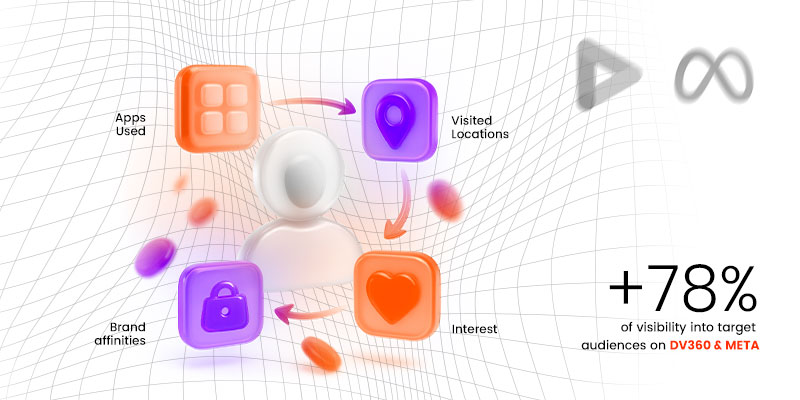
Stretch positions enrichment as adding behavioral intelligence beyond platform demographics:
- Apps used
- Visited locations
- Brand affinity
- Interest clusters
Signals platforms typically do not expose.
For GCC retailers, this enables:
- luxury shopper profiling
- high-LTV segment identification
- lifestyle-driven targeting refinement
- smarter reactivation strategies
The outcome is not just footfall measurement.
It is shopper intelligence.
Direct Answers Retail CMOs Search
What is footfall attribution?
Footfall attribution measures whether digital ad exposure led to physical store visits, enabling marketers to quantify offline ROI beyond clicks.
Why is offline attribution important in GCC retail?
Because GCC commerce remains highly store-driven, mall-centric, and experience-led. Digital ads influence offline visits, and measuring that impact is essential for budget accountability.
What is a competitor conquesting in retail marketing?
Competitor conquesting measures whether advertising shifted customers away from competitor locations, capturing incremental share.
Profile Enrichment, Mid-Funnel Intelligence & Activation Across Platforms
Modern marketing has entered a new phase.
The challenge is no longer simply reaching audiences. Platforms have made reach abundant.
The challenge is no longer even measuring performance. Dashboards are everywhere.
The real competitive advantage today is something deeper:
Understanding who your audiences actually are and what they do beyond the click.
Because in an environment defined by fragmentation, privacy constraints, and rising media costs, marketing performance is increasingly driven by:
- Audience quality, not volume
- Behavioral insight, not surface demographics
- Mid-funnel continuity, not siloed touchpoints
- Activation loops, not isolated impressions
This is where cross-channel measurement evolves into something more strategic: Marketing intelligence.
Why Platform Insights Are No Longer Enough
Most platforms provide some level of audience reporting.
Meta may tell you:
- Age bracket
- Gender split
- Broad interest categories
TikTok may tell you:
- Engagement rates
- Video completion
- Basic audience insights
Programmatic platforms may provide:
- Contextual signals
- Limited segment reporting
But these insights remain constrained.
They rarely answer the questions CMOs actually care about:
- What lifestyle segments are we attracting?
- What brands do these consumers over-index on?
- What real-world behaviors define them?
- Which audiences represent high lifetime value?
- How do we move them efficiently through the funnel?
This is the difference between:
Platform reporting and Customer intelligence.
Modern marketing performance is not driven by impressions. It is driven by audience truth.
The Shift: From Anonymous Exposure to Actionable Intelligence
Historically, advertising exposure created fleeting outcomes:
- A view
- A click
- A conversion attribution event
But in the next era of marketing, exposure should create something more durable:
An intelligence asset.
That means the audiences who engage with campaigns are not just “traffic.”
They are signals.
They represent:
- Intent
- Lifestyle patterns
- Competitive affinities
- Purchase propensity
- Future activation potential
This is where enrichment becomes strategic.
Stretch frames enrichment as leveraging large-scale behavioral touchpoints to append deeper attributes such as apps used, visited locations, brand affinity, interests, and other signals platforms typically do not share.
The implication is profound: Marketing measurement becomes marketing intelligence.
What Is Profile Enrichment in Enterprise Marketing?
Profile enrichment means enhancing campaign-exposed audiences with deeper attributes beyond platform-level demographics.
Instead of knowing:
“We reached women aged 25–34.”
Marketing leaders can understand:
- Which retail locations these users frequent
- Which apps they use
- Which brands they show affinity toward
- Which lifestyle clusters define them
- Whether they represent premium or competitor intent
This transforms campaign reporting into strategic insight.
Why This Matters for CMOs
Enterprise marketers are no longer competing on spend alone.
They compete on:
- Precision segmentation
- Customer understanding
- Mid-funnel acceleration
- Retention and lifetime value
- Cross-channel continuity
Enrichment enables all of these.
It turns campaign exposure into something reusable:
A durable audience intelligence layer.
Stretch positions this enrichment capability as part of a broader loop that connects exposure measurement to behavioral understanding and activation.
Case Example: Retail Intelligence Beyond Demographics
A regional beauty retailer faced a common limitation:
Platform-reported data were restricted to surface-level demographics.
They could not answer deeper questions:
- Who are these buyers really?
- What lifestyle segments do they belong to?
- How do we retarget them more intelligently?
By enriching campaign-exposed audiences with behavioral intelligence, apps used, visited locations, affinities, and interest clusters, the brand gained significantly deeper visibility.
This is the strategic shift:
From clicks to customer intelligence. From impressions to audience truth
Why Enrichment Is the Foundation of Mid-Funnel Strategy
Marketing funnels are no longer linear.
Consumers move fluidly across platforms:
- Social discovery
- Search intent
- Programmatic exposure
- Offline consideration
- Retail purchase
- Loyalty engagement
The mid-funnel is where most budgets are wasted and where most growth is unlocked.
The mid-funnel challenge is not awareness.
It is continuity.
How do you keep the journey connected across ecosystems?
Enriched audiences enable that continuity.
They allow marketers to build sequences such as:
- Exposed on TikTok – retargeted on Meta
- Engaged on programmatic – activated on social
- Store visitors – loyalty reactivation
- Competitor shoppers – conquest campaigns
This is how enrichment becomes activation.
Audience Activation: Closing the Loop Across Platforms
Many attribution systems stop at reporting.
They tell you what happened.
But marketing is iterative.
The real advantage comes from closing the loop:
- Identify engaged or exposed users
- Understand who they are
- Build actionable segments
- Activate them across platforms
- Shorten the conversion path
This is audience activation.
Stretch bridges measurement-and-activation loop across four interconnected pillars: match, attribution, enrichment, and retargeting.
Activation is what turns measurement into growth.
Case Example: Electronics Brand Cross-Platform Retargeting
An electronics brand ran a DV360 campaign with strong engagement.
But they lacked visibility:
- Who are these users?
- How do we re-engage them efficiently on social?
- How do we shorten the conversion path?
By matching and enriching engaged users, the brand revealed deeper behavioral and demographic attributes.
These audiences were then activated on Meta, creating cross-platform continuity.

This is mid-funnel intelligence in action:
Engagement – Enrichment – Activation – Conversion.
The Strategic Value: Building Audience Assets, Not Just Campaigns
One of the most important mindset shifts for CMOs is this:
Campaigns are temporary. Audience intelligence is durable.
Most media spend disappears the moment a campaign ends.
But enriched audience understanding creates long-term strategic value:
- Better segmentation frameworks
- Smarter creative personalization
- Improved retention modeling
- Stronger conquesting strategies
- More efficient budget allocation
This is why enrichment is not just a feature.
It is an enterprise advantage.
Cross-Channel Intelligence vs Traditional Attribution Tools
The broader market contains many measurement categories:
Mobile Attribution Platforms (AppsFlyer, Adjust)
- Strong for app installs and in-app events
- Less designed for offline store visit linkage or duplication visibility
Identity Platforms (LiveRamp, Experian)
- Strong for onboarding and activation infrastructure
- Not designed for real-time campaign exposure truth
Panel Measurement (Nielsen, Kantar)
- Strong for benchmarking and long-horizon brand studies
- Not built for granular mid-funnel activation
The gap is clear:
A unified intelligence layer that connects exposure, enrichment, offline outcomes, and activation across ecosystems.
Direct Answers CMOs Search
What is audience enrichment in advertising?
Audience enrichment enhances campaign-exposed users with deeper behavioral, lifestyle, and affinity attributes beyond platform demographics, enabling smarter targeting and activation.
Why is mid-funnel marketing so important?
Because most consumers do not convert immediately. Mid-funnel continuity across platforms accelerates consideration, improves retargeting efficiency, and reduces wasted spend.
How does cross-platform retargeting work?
Cross-platform retargeting activates engaged audiences from one ecosystem into another, creating continuity and shortening conversion paths. Your electronics case study showed 65% re-engagement after enrichment.
Competitive Landscape, Category Ownership, and the Future of Marketing Accountability
Digital advertising is entering its most demanding era.
Not because budgets are shrinking.
Not because channels are disappearing.
But because tolerance for ambiguity is ending.
Marketing is no longer judged by activity.
It is judged by accountability.
Boards, CFOs, and CEOs are asking harder questions:
- Are we reaching incremental customers or the same users repeatedly?
- Are we driving real-world outcomes or just digital engagement?
- Are we building audiences we can activate across platforms?
- Are we measuring business impact or platform optics?
Cross-channel measurement has shifted from a technical nice-to-have into a strategic requirement.
The Category Shift: From Attribution Tools to Incrementality Infrastructure
Most advertising technology categories were built for a simpler world:
- One dominant identifier
- One primary channel
- One measurable conversion path
That world no longer exists.
Today, advertising happens across:
- Meta
- TikTok
- DV360
- Snap
- Retail media networks
- Publishers
- Physical stores
And the consumer journey is fragmented by design.
This is why enterprise marketers increasingly need what can be described as:
- A unified exposure layer
- An incrementality spine
- A neutral measurement fabric
- A cross-platform truth system
Stretch positions itself within this emerging category by connecting exposure, duplication visibility, offline outcomes, enrichment, and activation into one loop.
The strategic point is not replacing platforms.
It is making the ecosystem measurable.
Competitive Landscape: Why Most Solutions Solve Only Part of the Problem
The measurement ecosystem is crowded, but fragmented.
Most alternatives fall into partial layers.
Understanding the market clearly requires mapping what each category is actually designed to do.
Mobile Attribution Platforms (AppsFlyer, Adjust, Kochava)
Mobile attribution platforms are leaders in one specific domain:
App install and in-app event attribution.
They excel at answering:
Which campaign drove this install?
Which ad triggered this purchase event?
What is the ROI for mobile acquisition spend?
Their strengths include:
Install attribution
Event pipelines
Fraud detection
Mobile ecosystem integrations
Where They Stop Short for Enterprise CMOs
Enterprise marketing increasingly requires answers beyond app funnels:
What is cross-platform audience duplication?
How much overlap exists between Meta and TikTok?
Did DSP exposure drive offline store visits?
Who are these users beyond device IDs?
Mobile attribution is powerful inside apps.
Cross-channel incrementality is broader across ecosystems.
Stretch addresses this broader enterprise gap by focusing on duplication visibility and offline outcome linkage rather than install-only attribution.
Identity and Onboarding Platforms (LiveRamp, Experian)
Identity platforms focus on a different layer:
Identity resolution and data onboarding.
They help brands:
- Connect CRM data to media activation
- Build identity graphs
- Enable privacy-safe targeting
LiveRamp is infrastructure.
But it is not a campaign intelligence system.
Where Identity Platforms Do Not Compete
They do not typically provide:
- Real-time cross-platform duplication visibility
- Unified exposure truth across paid media
- Store visit attribution tied to campaign exposure
- Marketer-facing optimization dashboards
Cross-channel measurement layers like Stretch operate closer to campaign truth: observing exposure, overlap, and outcomes rather than backend onboarding alone.
Panel-Based Measurement Giants (Nielsen, Kantar)
Nielsen and Kantar are giants of marketing measurement.
They are often used for:
- Brand lift studies
- Media effectiveness benchmarks
- Long-term modeling
- Industry comparatives
These approaches provide strategic credibility.
But they struggle with:
- Real-time optimization
- Audience-level activation
- Cross-platform duplication measurement
- Deterministic exposure-to-visit matching
Panel measurement answers:
“What was our brand impact over the quarters?”
Cross-channel exposure systems answer:
“What is happening in this campaign right now?”
Platform Attribution Dashboards (Meta, TikTok, Google)
The most important comparison is against the platforms themselves.
Most marketers still rely heavily on:
- Meta Ads Manager
- TikTok reporting
- Google attribution
- DV360 dashboards
These tools provide essential operational metrics.
But they remain structurally bounded:
Meta measures Meta.
TikTok measures TikTok.
Google measures Google.
None can measure the ecosystem.
This is the walled garden constraint.
That is why cross-channel measurement layers exist: to provide overlap visibility, incrementality truth, and offline outcome linkage beyond platform walls.
Capability View: What CMOs Actually Need
Enterprise marketing leaders do not buy categories.
They buy outcomes.
CMO Measurement Need | Platforms | AppsFlyer/ Adjust | LiveRamp | Nielsen/ Kantar | Cross-channel layer (Stretch) |
Cross-platform duplication visibility | ❌ No | ❌ No | ❌ No | ❌ No | ✅ Yes |
Unified exposure view across channels | ❌ No | Partial | ❌ No | ❌ No | ✅ Yes |
Offline store visit attribution | Partial | Limited | ❌ No | Modeled | ✅ Yes |
Behavioral audience enrichment | Limited | ❌ No | Partial | ❌ No | ✅ Yes |
Activation loop (match→enrich→retarget) | Partial | Limited | ✅ Yes | ❌ No | ✅ Yes |
This framing is what makes the category clear:
Stretch is not “another dashboard.”
It is an incrementality and intelligence layer across ecosystems.
Frequently Asked Questions
What is cross-channel measurement?
Cross-channel measurement is the ability to understand advertising exposure, overlap, and outcomes across multiple platforms rather than inside isolated silos. It helps marketers quantify incremental reach, duplication, and ecosystem-wide ROI.
What is incrementality in marketing?
Incrementality measures outcomes that would not have happened without advertising. It is the difference between correlation-based attribution and true causal impact.
What is audience duplication?
Audience duplication occurs when the same users are reached across multiple platforms, inflating reported reach and wasting budget.
What is offline attribution?
Offline attribution connects digital ad exposure to real-world outcomes such as store visits, footfall lift, and competitor switching. The QSR case study attributed 1,200 store visits and observed a 10% shift from competitor locations.
What is audience enrichment?
Audience enrichment enhances exposed users with deeper behavioral and lifestyle attributes beyond platform demographics, such as visited locations, app usage, and brand affinities.
Why are walled gardens a challenge in attribution?
Walled gardens are closed advertising ecosystems that restrict data sharing and limit independent cross-platform measurement. Platforms can measure themselves, but not the broader ecosystem. (Source: LiveRamp, Walled Gardens Explained)
Glossary: Key Terms for Marketing Leaders
Audience Duplication
Overlap of the same users reached across multiple platforms, inflating reach.
Incremental Reach
Unique reach that represents new users not previously exposed elsewhere.
Incrementality
Outcomes that occur because of advertising that would not have happened otherwise.
Offline Attribution
Connecting digital exposure to real-world outcomes, such as store visits.
Footfall Lift
The increase in store visits is attributable to campaign exposure.
Competitor Conquesting
Measuring whether campaigns shifted customers away from competitor locations.
Profile Enrichment
Appending behavioral intelligence to exposed audiences beyond platform demographics.
Walled Gardens
Closed ecosystems that limit cross-channel measurement.
Unified Measurement Layer
A neutral system connecting exposure and outcomes across fragmented media environments.
The Strategic Future: Why This Matters in GCC, Europe, and Beyond
The next decade of marketing measurement will be shaped by five forces:
- Incrementality Over Attribution Optics
- Offline Outcomes Over Digital Proxies
- Intelligence Over Impressions
- Ecosystem Truth Over Silo Metrics
- Privacy-First Governance
In regions like the GCC, where commerce remains deeply physical offline attribution, incrementality is not optional.
They are the new standard of marketing accountability.
Final Thought: Marketing Accountability as Infrastructure
The brands that win in the next era will not be the ones that buy the most impressions.
They will be the ones who measure the most truth.
Because in a fragmented ecosystem, competitive advantage is not about spending more.
It is knowing more:
- Who you truly reached
- What was incremental
- What drove offline impact
- Which audiences matter
- How to activate intelligence across platforms
Marketing made accountable.
Audiences made visible.
Results made real.