By Lucie Blahova
Marketing Lead, MEmob
Published June 2026
LinkedIn: https://www.linkedin.com/in/lucieblahova/
Using Mobility Intelligence to Forecast Consumer Demand, Tourism Recovery, Retail Growth & Investment Opportunities Across the GCC
Introduction
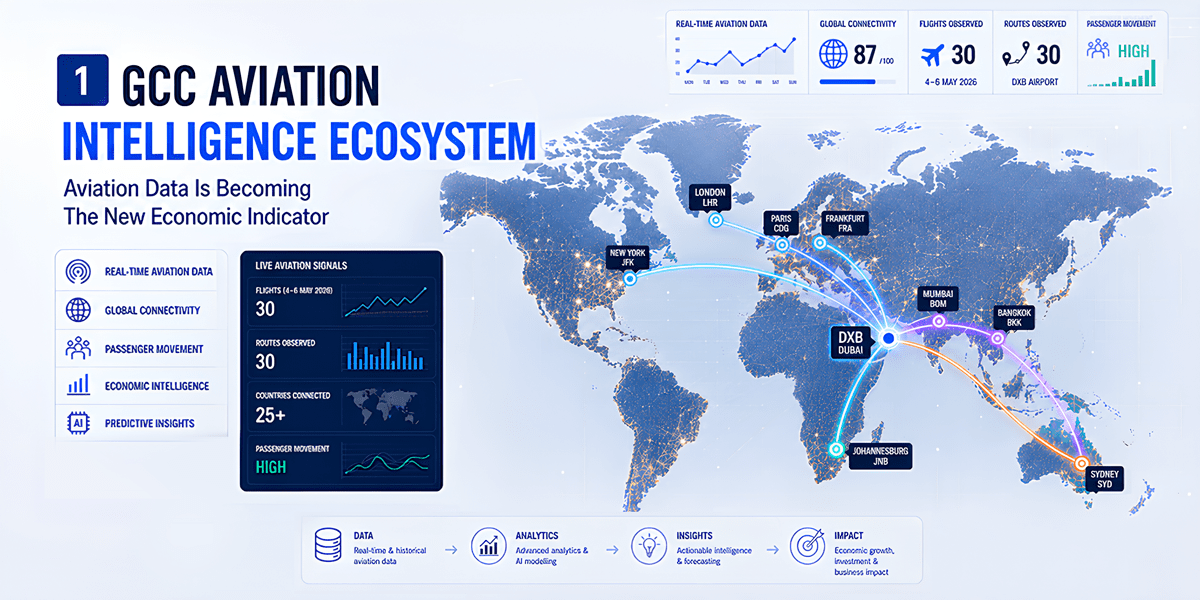
Aviation data is no longer just an airline metric. Across the GCC, flight activity increasingly serves as one of the earliest indicators of tourism demand, hotel occupancy, retail spending, investment activity, and broader economic growth.
As governments continue investing in tourism diversification, smart cities, and international connectivity, understanding how people move between markets has become essential for businesses seeking to anticipate future demand. Airlines, tourism boards, hotel groups, retailers, real estate developers, investors, and marketers all rely on mobility patterns to identify emerging opportunities before they become visible through traditional economic indicators.
By analyzing aviation activity and travel corridors connecting the GCC with Europe, Asia-Pacific, Africa, North America, and Oceania, organizations can gain a clearer understanding of future consumer behavior and economic momentum.
MEmob’s report explores how aviation intelligence can be used to forecast tourism recovery, hospitality performance, retail demand, investment activity, and business growth across the Gulf region.
Executive Summary
Aviation recovery across the GCC is no longer defined by passenger volume alone. The composition of travel demand, source market diversification, and corridor concentration provide significantly stronger indicators of future economic activity.
Analysis of Emirates traffic activity between 4 – 6 May 2026 reveals a highly diversified aviation ecosystem connecting the GCC to Europe, Asia-Pacific, Africa, and North America. Unlike previous recovery cycles that relied heavily on a limited number of source markets, current travel patterns suggest a broader and more resilient tourism recovery.
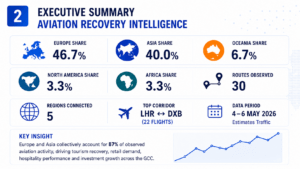
The findings indicate that Europe and Asia collectively account for approximately 87% of observed aviation activity, while long-haul markets continue strengthening regional connectivity and investment attractiveness.
Most importantly, aviation demand is translating into broader economic signals that impact tourism, hospitality, retail, luxury spending, commercial real estate, media investment, and cross-border business activity.
Methodology
This report is based on observed Emirates flight activity between 4 – 6 May 2026.
Route frequency, corridor concentration, geographic distribution, and recurring destination patterns were analyzed to identify travel demand trends and evaluate their potential implications across tourism, hospitality, retail, real estate, investment, and media sectors.
The objective is not simply to measure passenger volume but to understand the economic value created by traveler movement and international connectivity. The strength of international travel corridors is further reinforced by Dubai’s position as one of the world’s leading aviation hubs. According to Dubai Airports, Dubai International Airport continues to serve as a major gateway connecting Europe, Asia, Africa, and the Americas, supporting both tourism and business mobility.
Aviation Demand Distribution
Regional Share of Observed Traffic
| Region | Share of Traffic |
| Europe | 46.7% |
| Asia | 40.0% |
| Oceania | 6.7% |
| North America | 3.3% |
| Africa | 3.3% |
Strategic Insight
Nearly one out of every two observed routes involved Europe, reinforcing its position as the GCC’s largest premium tourism and business travel source market.
Asia accounted for four out of every ten routes observed, highlighting its continued importance in supporting workforce mobility, tourism demand, business travel, and regional commerce.
The presence of long-haul routes spanning Canada, Australia, and South Africa demonstrates the GCC’s increasing role as a global connectivity hub rather than a regional destination alone.
Route Concentration Analysis
Most Active Travel Corridors – DXB Airport (4–6 May 2026)
| Route | Frequency |
| London Heathrow | 22 |
| Bangkok | 13 |
| Paris CDG | 8 |
| Manchester | 6 |
| Mumbai | 5 |
| Delhi | 5 |
| Frankfurt | 4 |
Strategic Insight
London Heathrow represented approximately 35% of all recurring route appearances identified during the sample period, making it the single most influential international corridor observed.
The route’s dominance highlights the continued importance of the UK market not only for tourism but also for business travel, investment activity, luxury retail spending, education-related travel, and second-home ownership.
Bangkok emerged as the strongest Asian corridor, demonstrating balanced inbound and outbound demand. This suggests healthy two-way mobility rather than one-directional tourism dependency.
The presence of multiple European destinations among the highest-performing corridors reinforces the GCC’s continued attractiveness to premium travelers and high-spending visitor segments.
Tourism Recovery Intelligence
Source Market Diversification
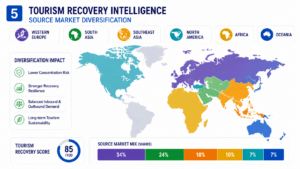
One of the strongest indicators of tourism health is source market diversity.
Historically, destinations that rely on a limited number of source markets experience greater volatility during economic slowdowns, geopolitical disruptions, or airline capacity constraints.
Current aviation patterns suggest that GCC tourism recovery is being supported by multiple geographic regions simultaneously:
- Western Europe
- South Asia
- Southeast Asia
- North America
- Africa
- Oceania
This diversified demand structure significantly reduces tourism concentration risk and strengthens long-term resilience.
Tourism Spending Implications
European travelers continue to represent some of the highest-spending visitor groups across the GCC. Their travel behavior is typically associated with longer average stay durations, higher hotel expenditure, increased luxury retail spending, greater participation in tourism experiences, and stronger visitation to cultural and entertainment destinations.
Asian travelers continue contributing significantly to overall tourism volume while supporting hotel occupancy, transportation networks, shopping destinations, and food and beverage sectors.
Hospitality Demand Forecast
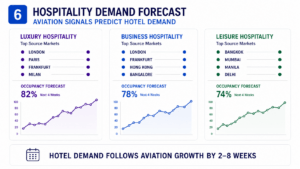
Aviation activity remains one of the strongest leading indicators for future hospitality performance.
Historically, hotel demand follows aviation growth with a lag period of two to eight weeks depending on traveler profile and destination.
Luxury Hospitality
Driven primarily by:
- London
- Paris
- Frankfurt
- Milan
These travelers are more likely to engage with luxury resorts, premium hotels, fine dining experiences, and branded residences.
Business Hospitality
Driven primarily by:
- London
- Frankfurt
- Hong Kong
- Bangalore
This segment supports weekday occupancy, conferences, exhibitions, and premium business travel services.
Leisure Hospitality
Driven primarily by:
- Bangkok
- Manila
- Mumbai
- Delhi
These corridors continue supporting broader hotel market occupancy and leisure tourism demand.
Retail & Consumer Spending Intelligence
International travelers remain one of the most valuable consumer segments within GCC economies.
Luxury Retail
Supported primarily by:
- UK travelers
- French travelers
- German travelers
- Long-haul visitors
Mass Retail
Supported primarily by:
- Indian travelers
- Southeast Asian travelers
- Regional expatriate movement
Duty-Free & Airport Retail
The diversity of international arrivals supports continued growth in:
- Luxury goods
- Cosmetics
- Electronics
- Fashion
- Premium gifting
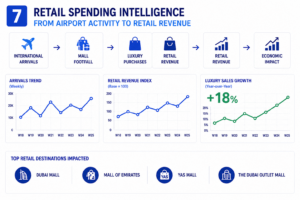
Airport activity increasingly serves as an early indicator of future footfall concentration across malls, entertainment destinations, and shopping districts.
Overall shopping & retail intelligence across UAE and selected shopping venues:
Real Estate & Investment Signals
Aviation intelligence increasingly acts as a proxy for cross-border investment activity.
Long-haul connectivity with Europe, Canada, Australia, and South Africa supports:
- Investor visitation
- Corporate expansion
- Relocation demand
- Property acquisition activity
The re-emergence and strengthening of these corridors suggest growing confidence in GCC markets as destinations for capital deployment and long-term economic participation.
Marketing & Media Intelligence
For CMOs and media planners, aviation intelligence offers a unique audience segmentation layer that extends beyond traditional demographics.
Rather than targeting audiences solely based on age, gender, or income, marketers can identify high-value traveler segments based on observed movement patterns and real-world behavior, including:
- Frequent travelers
- Luxury travelers
- Business travelers
- International tourists
- Transit audiences
- High-value visitor segments

Through location intelligence platforms such as AllPings, these audiences can be transformed into actionable Audience Cards, allowing brands to move beyond assumptions and target consumers based on where they have been, how they move, and the places they engage with most frequently.
For example, marketers can build audience profiles around:
- Travelers regularly visiting premium airports and airline lounges
- Frequent visitors to luxury retail destinations
- International business travelers arriving from key financial hubs
- High-intent tourists visiting entertainment, hospitality, and shopping districts
- Cross-border audiences demonstrating repeated travel behavior
By combining mobility intelligence, audience enrichment, and behavioral profiling, organizations can create more relevant campaigns, improve media efficiency, and activate audiences across digital advertising platforms with greater precision.
This enables media investment strategies that align more closely with real-world movement behavior and demonstrated purchase intent.
GCC Outlook for Q3 – Q4 2026
Current aviation patterns indicate four major trends likely to shape GCC growth during the second half of 2026.
Trend 1: European Demand Will Remain the Strongest Premium Tourism Driver
European travelers continue to represent one of the most valuable visitor segments across the GCC, contributing significantly to luxury retail, hospitality, business travel, and tourism spending. The continued strength of routes such as London Heathrow, Paris CDG, and Frankfurt suggests that Europe will remain a key source of high-value inbound demand throughout 2026.
Related Intelligence: Explore our 2025 Predictive Travel Analysis: UAE to understand how historical mobility patterns anticipated tourism demand and traveler behavior across the Emirates.
2025 Predictive Travel Analysis: UAE
Trend 2: Asian Markets Will Continue Generating the Largest Passenger Volumes
Asia remains one of the GCC’s most important connectivity regions, supporting workforce mobility, tourism demand, family travel, and business activity. Strong route performance across Bangkok, Mumbai, Delhi, and other major Asian destinations indicates sustained passenger growth across the region.
Related Intelligence: Our 2025 Predictive Travel Analysis: Qatar highlighted the growing influence of regional and international traveler flows in supporting tourism growth and destination demand.
2025 Predictive Travel Analysis: Qatar
Trend 3: Long-Haul Connectivity Will Support Investment, Business Travel & Premium Tourism
Long-haul routes increasingly act as indicators of broader economic activity. Connectivity with Europe, North America, Africa, and Oceania supports investor visitation, executive travel, corporate expansion, and premium tourism demand. As these corridors continue to strengthen, their economic impact will extend far beyond passenger numbers.
Trend 4: Diversified Travel Demand Will Strengthen Tourism Resilience Across the GCC
One of the strongest indicators of tourism resilience is source market diversification. The GCC continues to attract visitors from multiple geographic regions simultaneously, reducing reliance on any single market and creating a more balanced tourism ecosystem.
Related Intelligence: Our 2025 Predictive Travel Analysis: Saudi Arabia demonstrated how diversified traveler demand contributes to long-term tourism growth and supports broader economic development objectives.
2025 Predictive Travel Analysis: Saudi Arabia
Frequently Asked Questions
What is aviation intelligence?
Aviation intelligence refers to the analysis of flight activity, travel corridors, passenger movement patterns, and connectivity data to identify economic, tourism, and consumer demand trends.
How can aviation data predict tourism demand?
Flight activity often precedes tourism spending, hotel occupancy, retail footfall, and destination visitation. Changes in travel patterns can therefore act as early indicators of future demand.
Why are travel corridors important?
Travel corridors reveal where visitors originate, how frequently they travel, and which markets generate the highest economic value. Understanding corridor performance helps organizations prioritize investment and marketing efforts.
How does mobility data help marketers?
Mobility intelligence allows marketers to identify audiences based on real-world behavior rather than assumptions. This improves targeting accuracy, media efficiency, and campaign performance.
Why is source market diversification important?
Diversification reduces dependency on a limited number of markets and improves resilience during economic fluctuations, geopolitical disruptions, or travel restrictions.
About AllPings
AllPings is MEmob+’s location intelligence platform that helps brands understand real-world movement patterns, audience behavior, mobility trends, and footfall activity across markets.
By combining mobility intelligence with audience enrichment, organizations can identify growth opportunities, understand traveler behavior, optimize media investments, and measure real-world outcomes across tourism, retail, real estate, and hospitality sectors.
Executive Conclusion
Passenger volume measures recovery.
Travel corridors measure opportunity.
The aviation intelligence signals observed during May 2026 suggest that the GCC has entered a new phase of tourism recovery characterized by diversified international demand, expanding long-haul connectivity, and stronger cross-sector economic impact.
For tourism authorities, airlines, hotel groups, retailers, real estate developers, investors, and marketers, understanding where travelers originate, how they move, and what economic value they generate will become increasingly important than measuring passenger numbers alone.
Organizations that convert aviation intelligence into commercial strategy will be best positioned to capture growth opportunities throughout 2026 and beyond.
About the Author
Lucie Blahova is a Marketing Lead professional at MEmob, specializing in market intelligence, location intelligence, business transformation, and data-driven growth strategies. Her work focuses on translating mobility data, audience insights, and behavioral intelligence into actionable opportunities for marketers, tourism organizations, retailers, and business leaders across the GCC and international markets.