
By: Lucie Blahova
Marketing Lead MEmob
Published: 9th September 2026
Restricted Advertising Categories on Global DSPs: Why GCC Brands Still Lose Reach
Global demand-side platforms like The Trade Desk, Google DV360, and Amazon DSP restrict advertising categories: finance, healthcare, real estate, pharma, gambling, alcohol; using policies built primarily around US and EU regulatory norms. GCC advertisers in these same categories are often fully licensed and compliant under UAE, Saudi, or Qatari law, but still get blocked, throttled, or forced through lengthy certification processes because the platform’s restriction logic doesn’t recognize regional approvals. The result is a structural mismatch: brands that are legally compliant at home are treated as high-risk globally, losing reach on exactly the categories that dominate GCC ad spend.
Key Takeaways
|
|
|
|
What “Restricted Advertising Categories” Actually Means in Programmatic
In programmatic advertising, a “restricted category” is any vertical a DSP or ad exchange flags as requiring extra scrutiny before it’s allowed to buy media; sometimes blocked outright, sometimes gated behind certification, documentation, or country-by-country approval. This is distinct from prohibited content (illegal goods, hate speech), which no platform allows anywhere. Restricted categories are legal, often mainstream industries that a platform has decided carry reputational or regulatory risk.
The categories that show up most consistently across DSPs include:
- Financial services and products
- Healthcare, pharmaceuticals, and medical devices
- Real estate
- Alcohol
- Gambling and gaming
- Cryptocurrency
- Political and election advertising
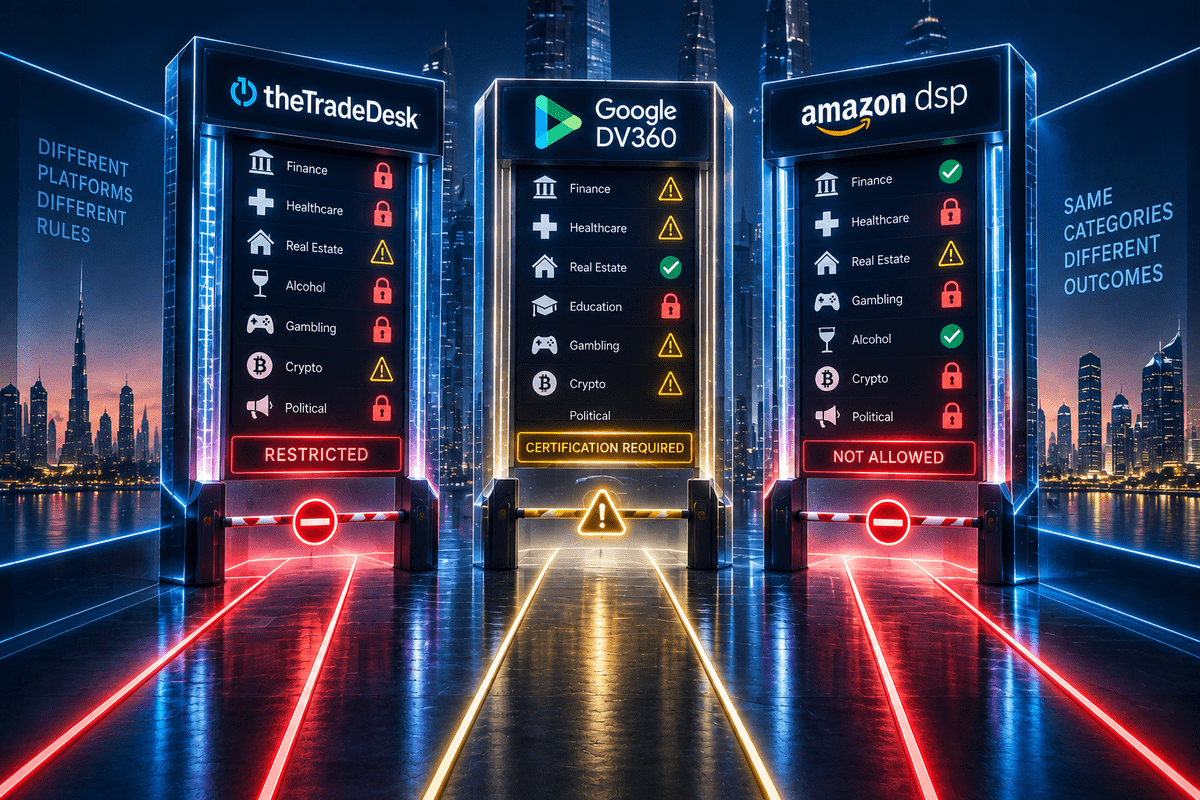
Every platform draws these lines differently, and that inconsistency is the whole problem for advertisers trying to plan a single, unified media strategy.
How The Trade Desk, Google DV360, and Amazon DSP Handle Restricted Categories
The Trade Desk, the largest independent DSP in the world, maintains a detailed ad content policy that blocks firearm imagery entirely; even for safety and education campaigns prohibits fireworks promotion outright, and layers additional restrictions across CBD, financial services, and political advertising, each requiring separate documentation before a campaign can go live.
Google DV360 publishes one of the most extensive restricted products and services lists in the industry: gambling and games, healthcare and medicines, election advertising, cryptocurrencies, financial products, government documents, event ticket sales, recreational drugs, alcohol, and prediction markets. Most of these require certification; sometimes through third-party verifiers like LegitScript before an advertiser can bid at all, and gambling content is only eligible in specific countries with per-domain, per-country certification.
Amazon DSP takes yet another position, prohibiting political advertising entirely including campaigns, elections, and public-debate issues where DV360 permits the same content with verification.
The net effect, as industry analysts put it plainly: no two DSPs draw the restricted-category line in the same place, and if a category is central to your business, the platform you buy through deserves the same strategic weight as your audience targeting.
| Platform | Restricted Categories | Certification Required | Certification Body / Process | Political Advertising | Notable Carve-Outs |
| The Trade Desk | Firearm-related content, fireworks/pyrotechnics, illegal drugs, CBD, financial services, political advertising | Yes, per category | Documentation submitted directly to The Trade Desk for each restricted category before a campaign can go live | Permitted, with restrictions and required disclosures | Firearm safety and education campaigns are allowed, but no gun or weapon imagery is permitted in the creative; even for education-focused ads. Fireworks promotion is prohibited outright |
| Google DV360 | Gambling and games, healthcare and medicines, election advertising, cryptocurrencies, financial products, recreational drugs, alcohol, adult content | Yes, for most categories | LegitScript certification for addiction services/CBD/pharmacy-adjacent categories; gambling requires separate Google pre-authorization, eligible only in specific countries | Permitted with certification | Gambling certification is domain-specific and country-specific; a single approval doesn’t cover every market or every site |
| Amazon DSP | Similar commercial categories to the above, plus a broader “sensitive/controversial topics” list (politics, religion, astrology) | Platform-specific, no cross-recognition of DV360 or Trade Desk certification | Amazon’s internal advertising policy review | Prohibited entirely; no exceptions | Political content is banned outright, with no certification path at all |
| Excelate DSP | Does not apply its own additional platform-level restrictions on top of the advertiser’s existing licensing status | No separate global certification process required from Excelate | Onboarding is built around the advertiser’s existing GCC licensing, rather than a US/EU-shaped platform certification layer | Handled per campaign, consistent with applicable regulations | Access to premium publisher, app, mobile, video, CTV, desktop, and DOOH inventory in one platform, without the extra documentation cycle imposed by global DSP certification systems |

The Regional Gap: GCC compliance vs Global DSP policy
This mismatch is sharper in the GCC than in the platforms’ home markets, because the sectors that dominate regional ad spend are exactly the ones global DSPs treat as restricted by default.
Under UAE law, categories including real estate, healthcare, finance, and education require prior sector-specific approval before any campaign can legally run; enforced through Federal Decree-Law No. 55 of 2023 on Media Regulation and the UAE Media Council’s Advertiser Permit regime, which became mandatory for anyone publishing paid or unpaid promotional content from February 2026 onward. As of January 2026, the UAE Media Council’s Advertiser Permit regime is administered by the National Media Authority (NMA), established under Federal Decree-Law No. 11 of 2025, which absorbed the Media Council’s functions along with those of the National Media Office and the Emirates News Agency,as per Lexology’s coverage . Healthcare and pharmaceutical advertising additionally requires pre-approval from the relevant health authority: DHA in Dubai, MOHAP federally, before a campaign is legally permitted to run, and real estate advertising must carry Trakheesi-approved project registration numbers on the creative itself. Similar sector-specific approval regimes exist across Saudi Arabia and Qatar.
That’s the friction: a GCC bank, hospital group, or property developer can be fully compliant; licensed, permitted, and locally approved and still hit a wall on a global DSP, because the certification systems those platforms rely on (built for US gambling law, EU pharma regulation, or American election disclosure rules) simply don’t recognize GCC regulatory bodies. Compliance at home doesn’t translate into eligibility on the platform.
| International DSP restriction logic | GCC regulatory reality | |
| Built around | US/EU legal frameworks, US-centric certifiers (e.g. LegitScript) | UAE Media Council, DHA/MOHAP, RERA, and equivalent GCC bodies |
| Healthcare/pharma | Certification required; often unavailable to non-US/EU advertisers | Pre-approved by DHA/MOHAP before the campaign can legally run |
| Real estate | Frequently treated as a restricted financial-adjacent category | Requires RERA registration number on the creative itself |
| Finance | Certification and documentation gated per-platform | Sector-specific approval required by UAE/GCC law |
| Practical effect | Brand is licensed at home, blocked or throttled on the platform | Brand is already fully compliant before the campaign is built |

Why this matters for GCC agencies and brands specifically
For media planners working across the GCC, this isn’t an edge case; it’s a recurring bottleneck. Real estate, finance, healthcare, F&B, and education routinely rank among the highest-spending verticals in the region, and every one of them sits inside a global DSP’s default restricted list. The practical consequences:
- Fragmented buying. Agencies split spend across multiple DSPs to patch together reach, losing unified frequency capping, measurement, and optimization.
- Slower time-to-market. Certification and documentation cycles delay campaign launch for categories that are already legally cleared to run.
- Reduced premium access. Brands default to lower-tier or remnant inventory rather than premium publishers and apps that opt out of restricted-category buyers.
- Compliance work done twice. Regional legal and marketing teams clear a campaign locally, then have to re-prove that clearance to a platform that wasn’t built to recognize it.

How Excelate DSP closes the gap
This is precisely the structural problem Excelate DSP is built to solve. Rather than applying a blanket, US/EU-shaped restriction policy to GCC advertisers, Excelate gives licensed, locally-compliant brands in finance, healthcare, real estate, and other regionally-restricted categories access to premium publisher, app, mobile, video, CTV, desktop, and DOOH inventory in one platform without the certification bottleneck that stalls campaigns on major global DSPs.
It’s part of a broader shift MEmob has been tracking across our location and market intelligence work in the GCC: platforms designed elsewhere consistently under-serve advertisers operating under GCC-specific regulatory frameworks, whether that’s location intelligence versus geospatial intelligence or, here, restricted-category access. Closing that gap is a regional problem that needs a regional-first platform, not a global one retrofitted after the fact.
FAQs
What counts as a “restricted category” in programmatic advertising?
A restricted category is a legal, mainstream industry; such as finance, healthcare, real estate, alcohol, or gambling that a DSP flags as requiring extra certification or approval before an advertiser can buy media in it. It’s different from prohibited content, which no platform allows under any circumstances.
Why do global DSPs restrict categories that are legal in the GCC?
Most global DSPs build their restriction policies around US and EU regulatory frameworks and rely on certification bodies (like LegitScript) that are not designed to recognize GCC regulators such as the UAE Media Council, DHA, MOHAP, or Trakheesi. A brand can be fully licensed under GCC law and still be treated as restricted by the platform’s default policy.
Which advertising categories are most affected in the UAE?
Real estate, healthcare, pharmaceuticals, finance, and education all require prior sector-specific approval under UAE law before a campaign can legally run and all five are also commonly restricted or certification-gated on major global DSPs.
Does being certified on one DSP transfer to another?
No. Certification and documentation requirements are platform-specific. An advertiser certified for a category on DV360 still has to go through The Trade Desk’s or Amazon DSP’s separate process, since none of the major platforms share restriction frameworks.
How does Excelate DSP handle restricted categories differently?
Excelate doesn’t apply its own additional platform-level restrictions on top of an advertiser’s existing GCC licensing status. Onboarding is built around the advertiser’s existing local licensing rather than a US/EU-shaped certification layer, giving access to premium omnichannel inventory: mobile, video, CTV, desktop, and DOOH; without the extra documentation cycle imposed by global DSP certification systems.