
By Mitali Jadia
Marketing Manager, MEmob
Published June 2026
LinkedIn: Mitali Jadia
Plan early. Map the rush. Measure the visit.
Back-to-school across the UAE, Saudi Arabia, and Qatar is a six-week commercial event worth approximately AED 3 billion (USD 820M) in the UAE alone, driven by 1.5 million UAE students returning to school in late August. Online sales grew 18% year-on-year in 2025, with mobile commerce now at 47% of UAE BTS purchases. Saudi Arabia has just transitioned back to a two-semester academic calendar, while a national AI curriculum reaches 6+ million students from 2025-2026. The GCC private K-12 market grows from $33.59B in 2025 to $65.71B by 2031 at an 11.83% CAGR. Four behaviourally distinct family segments (Early Planner, Last-Minute Family, Mall Family, Premium Brand Family) operate across three campaign windows (research May-July, peak rush August 15-September 1, settle-in September-October). The brands that win this season will be the ones that map family movement and measure footfall, not the ones with the loudest media plans.
GCC Back-to-School 2026: The Numbers at a Glance
| Metric | Value | Source |
| GCC private K-12 market (2026) | USD 37.56 billion | Mordor Intelligence |
| GCC private K-12 market (2031 forecast) | USD 65.71 billion | Mordor Intelligence |
| GCC private K-12 CAGR 2026-2031 | 11.83% | Mordor Intelligence |
| GCC total student enrolment forecast 2029 | 15.5 million (from 14M) | Education UAE Outlook |
| UAE BTS retail sales 2024 | AED 3 billion (USD 820M) | AGBI / Colliers Mena |
| UAE average BTS spend per student | AED 2,000 (USD 545) | AGBI |
| UAE online BTS sales growth 2025 | +18% YoY | Campaign Middle East |
| UAE BTS mobile share | 47% (2025), up from 39% (2023) | Flowwow & Admitad |
| Saudi Arabia 2026 education budget | SAR 202 billion (USD 53.82B) | Mordor Intelligence |
| KSA’s share of the GCC private K-12 market | 37.05% (2025) | Mordor Intelligence |
| KSA students reached by the national AI curriculum | 6+ million from 2025-2026 | EDT & Partners |
| Qatar K-12 CAGR through 2031 | 12.03% | Mordor Intelligence |
| DXB peak BTS travelers (Aug 13-25, 2025) | 3.6 million | OneArabia |
| Global retail GenAI traffic growth (July 2025) | +4,700% YoY | Adobe / Shopify |
Look at Any GCC Mall on the Last Saturday of August
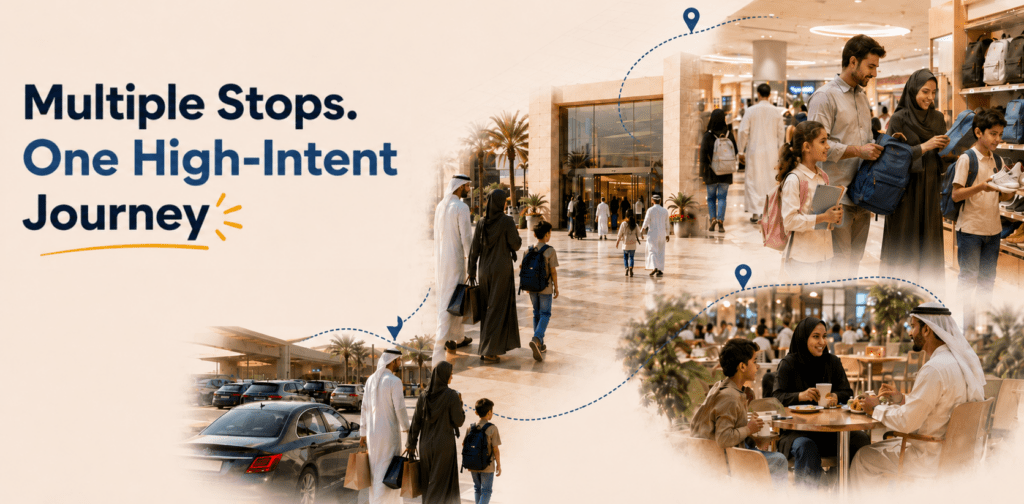
You don’t need a survey to tell you what’s happening.
- The food court is at capacity.
- The uniform store has a queue that stretches into the corridor.
- A child tries on shoes while a parent answers a work call.
- Someone’s holding a laptop box, mid-decision.
- The carparks are full.
- The line at the perfume counter has somehow doubled.
Now zoom out.
This isn’t one mall.
It’s happening simultaneously in every major mall across Dubai, Abu Dhabi, Sharjah, Riyadh, Jeddah, Doha, and Al Khobar, in a tight 10-day window, year after year.
That is not just a retail moment.
That is a movement pattern.
And if brands can see that pattern on a map, they can take action.
Back-to-school in the GCC is no longer just about stationery, uniforms, and school bags. It is a high-intent family movement window shaped by school calendars, summer return travel, mall behaviour, mobile commerce, education spending, and last-minute household decisions.
This is what MEmob+ has been working on for years. Not only “what creative / media should we run for back-to-school?” but “Where are families moving, when are they in-market, and how do we prove that marketing drove real-world action?” Because the answer to the second question makes the first question almost trivial.
That is where maps and analytics become more valuable than media alone.
What the Map Tells Us
Before we get to creative, channels, or budget, here’s what the data is showing us across the UAE, Saudi Arabia, and Qatar right now:
1.5 million students are about to head back to school in the UAE alone. Last year’s back-to-school sales hit AED 3 billion ($820 million), before the 2025 surge. Online sales jumped 18% year-on-year in the UAE during the 2025 BTS season. Mobile commerce now accounts for 47% of BTS purchases in the UAE, up from 39% in 2023. Source: AGBI.
That’s not a slow shift. That’s a stampede in slow motion.
And the regional growth is structural: the GCC private K-12 market is forecast to grow from $33.59 billion in 2025 to $65.71 billion by 2031, an 11.83% CAGR. The student base is growing. School networks are expanding. Household spending is rising. Year after year, the opportunity keeps compounding. Source: Mordor Intelligence.
This is the important part.
The peak does not happen evenly.
It concentrates.
Families research earlier, compare options, wait for offers, return from summer travel, and then complete a large part of the journey in a short late-August window.
For marketers, this means August should not be treated as a normal awareness period.
It is a live movement window.
Families are moving between homes, malls, uniform stores, electronics retailers, supermarkets, restaurants, delivery apps, airports, and schools.
The brands that can map this movement will always have a sharper strategy than those that simply buy reach.
What we see in our own data:
By May 2026, retail shopping intent among parent audiences had already reached 19.7% in the UAE, 18.9% in KSA, and 13.6% in Qatar. By the August 2026 back-to-school peak, MEmob forecasts retail shopping intent to rise to 23.8% in the UAE, 23.0% in KSA, and 15.8% in Qatar.
Mall and retail mobility is also expected to climb sharply, reaching 20.5% in the UAE, 18.8% in KSA, and 21.0% in Qatar by August.
That matters because the back-to-school rush is not only digital. It is physical. Families research online, compare offers, return from travel, visit malls, buy across categories, and complete last-minute purchases in-store.
The commercial opportunity sits in the connection between the two.
- Digital intent tells us who is preparing.
- Mobility tells us where they are likely to act.
- Attribution tells us whether the campaign moved them.
Families Are Spending, But the Language Needs to Be Accurate
Back-to-school costs can be high, but the claim must be precise. Khaleej Times reported that UAE parents can spend up to AED 2,000 per child on back-to-school essentials, excluding tuition. That does not mean every family spends AED 2,000.
It means the category can carry meaningful household pressure, especially when uniforms, shoes, bags, books, transport, devices, tutoring, lunchboxes, and extracurricular needs come together.
Online category demand also shows how wide the opportunity has become. In the UAE, back-to-school online baskets, fashion accounted for 27% of purchases, followed by electronics at 18%, home and garden at 14%, car products at 10%, and toys and hobbies at 8%. Across MENA, electronics accounted for 21% of back-to-school orders, followed by fashion at 19%.
That is why back-to-school should not be limited to school-supply brands.
It is a family readiness moment. And many categories can own part of that journey.
The strongest signal is not one category. It is the size of the basket.
Across UAE, KSA, and Qatar, back-to-school demand is spread across almost every household category:
| Category | Projected Audience Across UAE, KSA & Qatar |
| Stationery, books & school supplies | 1.32M |
| Bags, lunchboxes & accessories | 1.32M |
| Grocery, snacks & lunchbox food | 1.32M |
| Electronics | 1.03M |
| Tutoring, edtech & learning apps | 398K |
| Uniforms, clothing & footwear | 373K |
Saudi Arabia Changes the Rhythm
Saudi Arabia cannot be treated as just another GCC market in the same campaign calendar.
The Saudi Cabinet approved a return to a two-semester academic year for public schools starting in the 1447/1448 Hijri school year, corresponding to 2025–2026, while maintaining a 180-day school year.
This matters for marketers because calendar changes reshape spending rhythm.
When the school year changes, the family planning cycle changes with it.
- Holiday timing changes.
- Mid-year breaks shift.
- The first-semester window becomes more important.
- Campaign calendars built around the previous rhythm may become less effective.
Saudi Arabia also allocated SAR 202 billion to education in its 2026 budget, including SAR 30 billion for operating expenses.
And the country introduced a national AI curriculum for six million students in the 2025–2026 academic year.
For brands, back-to-school in Saudi Arabia is about more than school supplies.
It is about household readiness.
- Devices
- Connectivity
- Data plans
- Education tools
- Digital learning
- Family bundles
- Premium retail
- Banking products
- Longer-term education planning
Qatar Shows Why Mall Behaviour Matters
Qatar’s 2025–2026 academic year had students returning to school on 31 August 2025, creating a slightly later back-to-school rhythm than the UAE.
Qatar also shows why mall behaviour cannot be ignored.
In Qatar, school began on August 31. Mall visits average 1-2 times per week for about 2.7 hours, and visitors combine 3.2 activities per trip, pairing shopping with dining, entertainment, or fitness. The Doha mall is not a transaction. It’s an afternoon. Source: Campaign Middle East.
That is not a transaction. That is an afternoon.
For brands, this changes the planning logic.
A mall visit may include uniforms, shoes, lunch, coffee, cinema, electronics, beauty, groceries, and impulse purchases in one journey.
So the opportunity is not just to advertise near a mall.
The opportunity is to understand:
- Which family segments visit which malls?
- How long do they stay?
- What else do they do?
- Which categories are part of the same trip?
- Which locations attract repeat visits?
- Which competitor destinations pull the same audience?
That is where mall marketing becomes movement intelligence.
AI Search Is Becoming Part of the Shopping Journey
Back-to-school discovery is also changing.
Parents are no longer just searching on Google. They are asking AI tools for recommendations, comparisons, and shortcuts.
Adobe reported that traffic to U.S. retail sites from generative AI sources grew 4,700% year-on-year in July 2025, while 38% of surveyed U.S. consumers said they had used generative AI for online shopping. Adobe also found that shoppers use AI for research, product recommendations, deal-seeking, shopping lists, and gift ideas.
This is U.S. retail data, not GCC-specific data, so it should be treated as a directional signal.
But the direction is clear.
Consumers are becoming more comfortable asking AI-led questions like:
- Best tablet for a 12-year-old.
- Where to buy school uniforms near me.
- Back-to-school offers in Dubai.
- Best laptop for students in Saudi Arabia.
- School lunchbox ideas for working parents.
For brands, this means visibility is no longer only about Google rankings.
It is also about whether the brand, store, category, and location are understandable to AI-powered discovery platforms.
But AI visibility is only the beginning. The stronger advantage comes when digital intent is connected to physical-world movement.
The Mistake Most Brands Are Still Making
Most back-to-school media plans look something like this: “Run display from August 1, weigh up around mid-month, throw a mall takeover at the final weekend, sponsor a back-to-school list on a parenting site.”
Safe? Yes.
Predictable? Absolutely.
Effective? Not when it leaves up to 40% of the actual opportunity on the table.
Because here’s what’s actually happening in the data:
- The same family that orders uniforms online from a Karama shop on August 22 is the family that landed at DXB on August 18 from a six-week summer abroad.
- They went home, slept, and ordered groceries. The next day, they hit the mall, three of them at once across the family.
- They bought stationery, ate at the food court, browsed electronics without buying, then drove home and ordered the laptop online that night because the in-store stock was wrong.
- The next weekend, they were back at a different mall to finish what they didn’t get done.
That’s one family. Five touchpoints. Three locations. Two weeks. And almost every brand in their journey treated each interaction as a separate event.
If you can map that journey and we can, you can show up at four of those five touchpoints with messaging that actually fits the moment. That’s the difference between media that interrupts and media that converts.
The Four Families We See on the Map
“Parents aged 25–44” is not a strategy.
It is a broad demographic bucket.
Back-to-school behaviour in the GCC is more specific. The strongest campaigns should be built around movement, timing, and intent of the back-to-school audience segments.
Generic “parents with school-age children” targeting wastes the budget. Behavioural data across the GCC reveals four distinct shopping personalities, each requiring different timing, channels, and creative.
The Early Planners
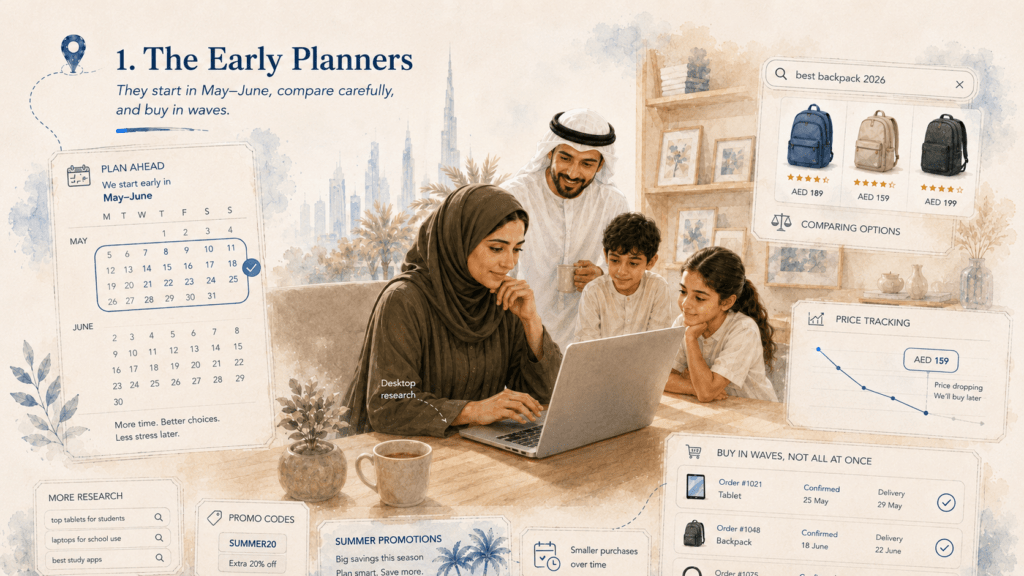
The largest premeditated segment. Begins research in May-June, monitors prices, comparison shops, and looks for sales aligned with summer promotions like Dubai Summer Surprises (DSS).
Behaviour signals:
- Heavy desktop research in May-June
- High engagement with category content (“best backpack 2026,” “top tablets for students”)
- Budget-conscious; tracks deals and promo codes
- Often, a working mother in a dual-income household
- Higher AOV but spread across multiple smaller transactions
Best for: retail (early bundle promotions), e-commerce (loyalty programs), banking (installment offers on electronics)
The Last-Minute Family
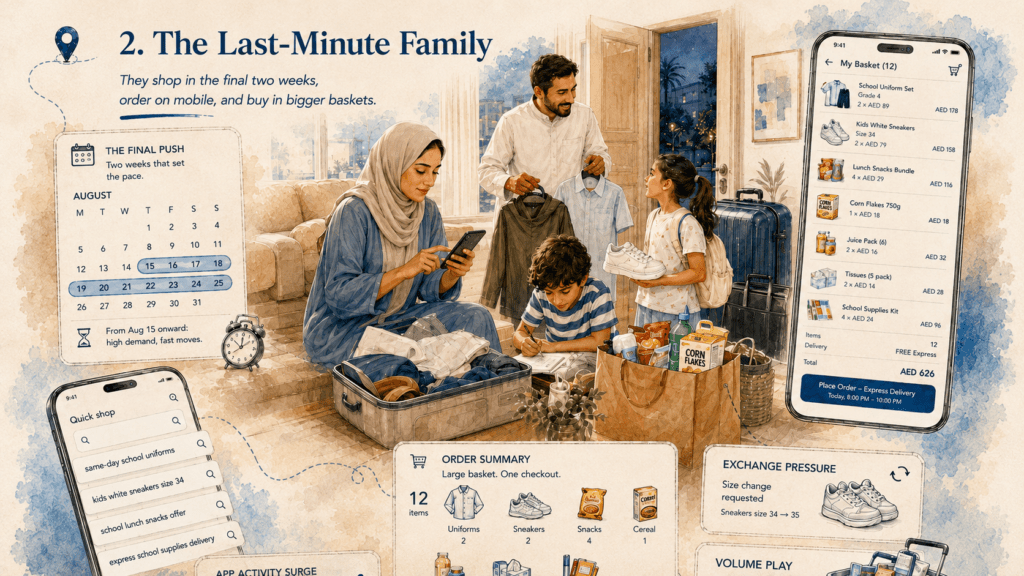
The volume play. Activates in the final two weeks before school starts, often returning from summer vacation with limited time to shop. The Back-to-School season has become one of the most powerful retail moments in the MENA retail calendar, second only to mega-events like Black Friday and Ramadan. Our data shows families across the region reshaping their habits, consolidating purchases into larger baskets, shifting more spending to mobile, and balancing value-driven shopping with premium buys.
Behaviour signals:
- Mobile-first ordering
- Bundled, larger basket sizes
- Heavy app usage from August 15 onwards
- Often booking groceries and supplies in the same checkout
- High cancellation/exchange rate due to time pressure
Best for: mobile-first retail, food delivery, quick commerce, electronics with same-day delivery
The Mall Family
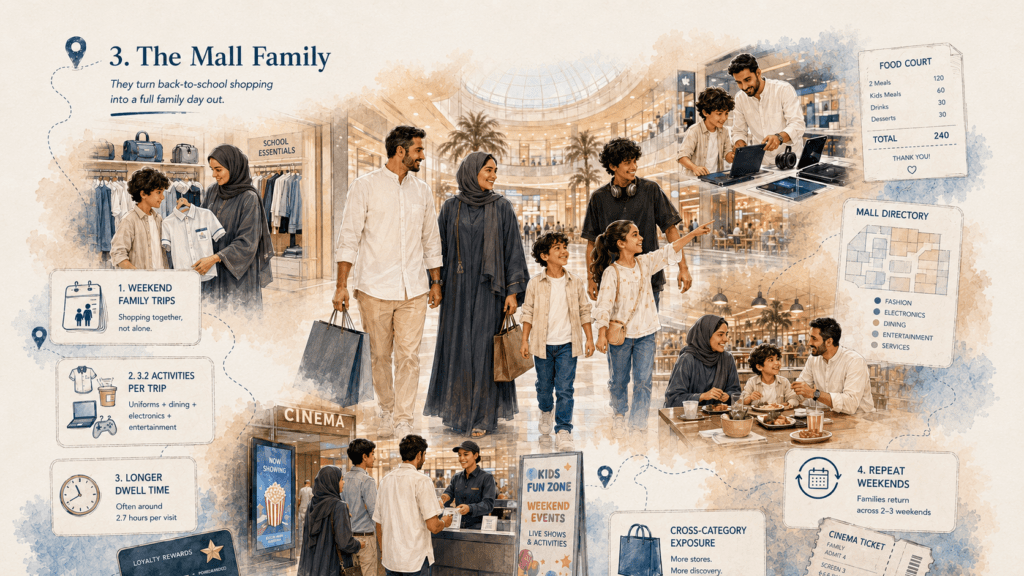
The high-engagement segment. Treats back-to-school shopping as a family event. On average, visitors combine 3.2 activities per trip, pairing shopping with dining, entertainment, or fitness. Qatar nationals are even more likely to engage in leisure activities such as cinema and events. Both Ipsos and the Doha Festival City 2025 Consumer Survey confirm malls are part of weekly life. Ipsos finds most visit 1–2 times weekly for around 2.7 hours.
In the UAE, some uniform shops in the UAE are seeing an average of more than 500 customers a day as parents prepare for the back-to-school season. Khaleej Times
Behaviour signals:
- Weekend mall visits with the full family
- Multi-category basket: uniforms + dining + electronics + entertainment
- Higher dwell time and repeat visits across 2-3 weekends
- Strong cross-category exposure to brands
Best for: mall-based retail, F&B, cinema/entertainment, fashion, home electronics, family activities
The Premium Brand Family
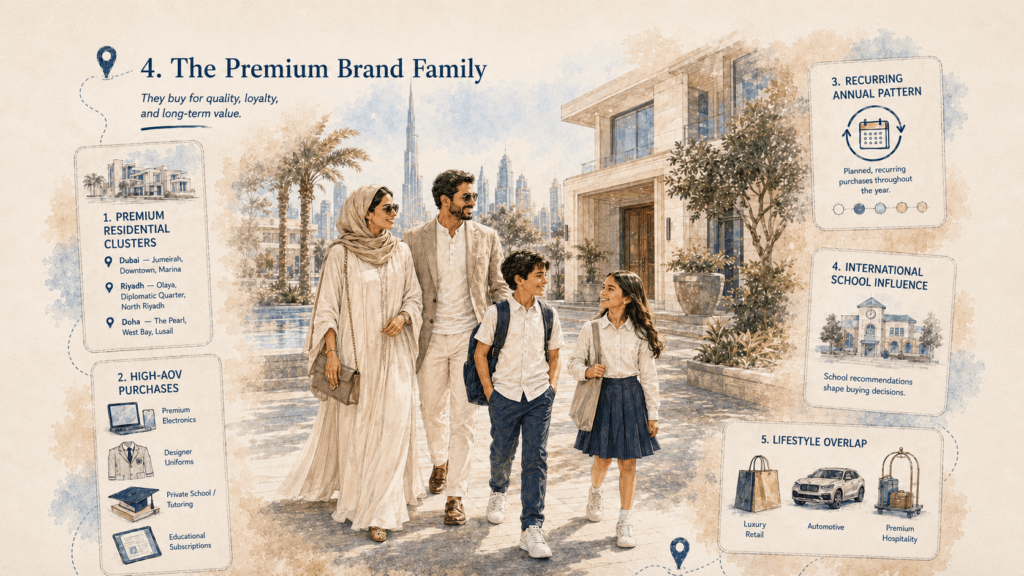
The high-ticket segment. Concentrated in Dubai (Jumeirah, Downtown, Marina), Riyadh (Olaya, Diplomatic Quarter, North Riyadh), and Doha (Pearl, West Bay, Lusail). Spends on private school, premium tutoring, branded electronics, designer uniforms, and educational subscriptions. Less price-sensitive, higher loyalty, more brand-driven.
Behaviour signals:
- Concentrated geo-clusters in premium residential areas
- Recurring annual purchase pattern
- High-AOV transactions on electronics and tech
- Influenced by international school recommendations
- Strong cross-category overlap with luxury, automotive, and premium hospitality
Best for: premium electronics (Apple, Samsung, gaming), private tutoring services, edtech, premium banking products, luxury retail, family-oriented hospitality
Three Back-to-School Windows. Most Brands Show Up in One.
As with every major retail moment in the GCC, back-to-school behavior clusters into three predictable windows. Brands that map their activation calendar against these windows outperform those running flat-and-continuous campaigns.
Window 1: Research & Planning (May – July)
The Early Planner segment is in the market. Search interest builds slowly. Worldwide search interest in “school supplies” started accelerating in May this year, whereas last year’s spike started later in June. Shoppers are being strategic about getting the best buys.
In the GCC, this is also when major mall events overlap with planning intent. Dubai Summer Surprises typically runs through late June into July, creating an early-window promotional peak that smart brands tie to back-to-school messaging.
What brands should activate:
- Category-defining content (guides, comparisons, “best of” listings)
- Search-led campaigns on Google + AI search engines (ChatGPT and Perplexity now drive measurable consideration traffic)
- DSS tie-in promotions for UAE families
- Email and CRM nurture for previous-year customers
- Loyalty program activation
- Influencer content seeded in May-June (lead time for production)
Measurement focus: Search demand growth, content engagement, list growth, returning customer flag
Window 2: Peak Rush (August 15 – September 1)
This is where most of the commercial value lies. The end of August traditionally marks the busiest shopping period as families prepare for the new school term. OneArabia
The Last-Minute Family and Mall Family segments dominate this window. Mobile commerce surges, mall footfall peaks, delivery slots fill up, uniform shops report 500+ customers per day, and DXB sees 3.6 million arrivals in 13 days. Every category, from electronics to QSR, experiences a behavioural spike.
What brands should activate:
- Geo-fenced mobile campaigns to residential clusters
- Mall fan-zone style activations (DOOH, sampling, in-store experiences)
- Same-day and 2-hour delivery messaging
- Airport → home → mall sequential targeting
- Dynamic creative tied to school start date (countdown messaging)
- Offer-driven creative (installments, BNPL, family bundles)
- Real-time campaign optimization based on store visit data
Measurement focus: Footfall attribution (mall and store visits), conversion lift versus control, basket size, repeat visits, cost per incremental visit.
Window 3: First-Month Settle-In (September – mid-October)
Often missed entirely by brands that wrap up campaigns when school starts, but the data shows commercial activity continues. Families discover what they forgot to buy. After-school routines kick in, driving F&B and entertainment spend. Tutoring decisions get made. Replacement purchases (broken supplies, outgrown shoes, lost lunchboxes) cluster in weeks 2-4 of the term.
What brands should activate:
- After-school F&B and quick commerce campaigns
- Tutoring and edtech activation (decisions made by October)
- Replenishment messaging for consumables
- Sports and extracurricular activity campaigns
- Banking and savings products (post-major-spend window when families reconsider finances)
- Family entertainment for weekend-after-school occasions
Measurement focus: Repeat purchase rate, lifetime value lift, after-school visit patterns, category cross-sell
Category Playbooks for GCC Back-to-School 2026
What This Means for Different Categories
Specifics, by category, based on what we’re seeing in the data.
Retail and Mall Brands: Concentrated Footfall, Multi-Category Baskets
GCC malls during the late-August rush are among the highest-density commercial environments globally. Doha Festival City data confirms most visit 1–2 times weekly for around 2.7 hours, and during the back-to-school window, this multiplies
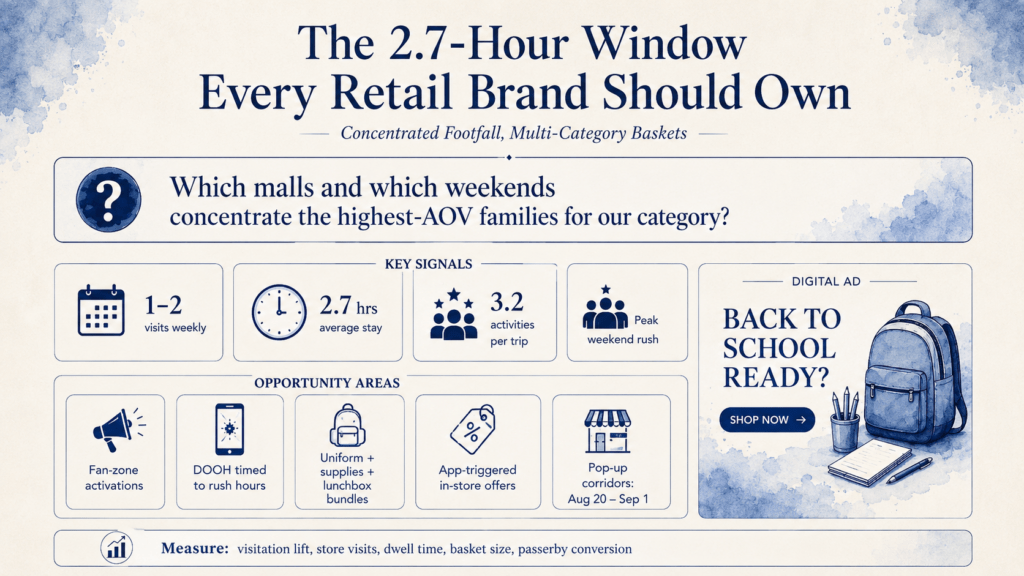
Campaign opportunities:
- Mall fan-zone style activations with sampling, demos, and family experiences
- DOOH messaging mapped to peak weekend rush hours
- Multi-category bundles (uniform + supplies + lunchbox at single price point)
- Personalized in-store offers triggered by app-based location signals
- Pop-up presence in high-traffic mall corridors from August 20 to September 1
- Competing against direct competitor stores in the same mall
Measurement priorities: mall visitation lift versus baseline weekends, store visits within the mall, dwell time, basket size, conversion-from-passerby rate
Strategic question:
- Which malls will concentrate the highest-value families?
- Which weekends will carry the strongest basket intent?
- Which audiences are likely to visit competitor stores first?
- Which shoppers can be moved from corridor traffic into store traffic?
| FORECAST – Projected Intent Strength by August 2026 (BTS Peak) | ||||
| Signal | UAE Aug 2026 | KSA Aug 2026 | QATAR Aug 2026 | Overall |
| Mall & Retail Mobility | ↑ 20.5%
(now: 12%) |
↑ 18.8%
(now: 11.2%) |
↑ 21%
(now: 12.8%) |
↑ 19.5%
(now: 11.6%) |
QSR and Food Delivery: After-School and Family-Meal Spikes
GCC back-to-school creates two distinct food behaviours that QSR brands can target separately:
The first is the family meal during shopping trips. Mall Family segment ordering at food courts and casual dining during weekend mall visits. The second is the after-school routine establishment, once school begins, school-pickup-to-home and weeknight family meal patterns emerge that didn’t exist in summer.
Campaign opportunities:
- Food court promotional partnerships during the peak August rush
- “After school” meal bundles are activated from September onwards
- Lunch box-friendly QSR positioning for working parents
- School pickup zone proximity targeting
- Weekend family meal deals tied to mall visits
- Delivery-focused promotion for the Last-Minute Family segment
Measurement priorities: Restaurant visits during shopping trips, after-school visit pattern emergence, delivery order frequency in school catchment areas
Strategic question: Where in the school day or weekly routine does our brand fit, and how do we activate that occasion?
| FORECAST – Projected Intent Strength by August 2026 (BTS Peak) | ||||
| Signal | UAE Aug 2026 | KSA Aug 2026 | QATAR Aug 2026 | Overall |
| Grocery / Food | ↓ 11%
(now: 11.7%) |
↓ 10.8%
(now: 11.2%) |
↓ 11.5%
(now: 12%) |
↓ 10.9%
(now: 11.4%) |
Telecom: Devices, Family Plans, and Student Connectivity
The back-to-school season is a major window for device and plan upgrades for UAE and KSA families. Premium families upgrade student phones and tablets. Older students transition to their own data plans. Families reassess home internet for online learning. KSA’s nationwide AI curriculum, beginning in the 2025–2026 academic year, reaching 6+ million students, drives further device demand. Edtpartners
Campaign opportunities:
- Student-targeted device promotions (smartphones, tablets, laptops)
- Family plan upgrades with device + data bundles
- Home internet promotions tied to online learning needs
- Educational app and content partnerships
- The BNPL device offers a tie to the school start
- Targeting within premium residential clusters where private school families concentrate
Measurement priorities: Plan upgrade rates, device sale lift, retail store visit impact, share of family-segment
Strategic question: Which household types are most likely to upgrade devices around school start, and where do they live?
Banking, Fintech, and BNPL: The High-Spend Crunch Window
Late August is a major financial pressure point for GCC families. Tuition payments, uniforms, electronics, and supplies create the largest discretionary spending window of the year outside Ramadan. This makes it prime time for BNPL platforms (Tabby, Tamara, Postpay), installment-friendly credit cards, and family-targeted financial products.
Campaign opportunities:
- BNPL promotions on big-ticket items (laptops, tablets, premium uniforms)
- Cashback campaigns on educational categories
- Co-branded retail partnerships at peak mall windows
- Family financial planning content in the May-July research window
- Salary-day-aligned activation (most GCC families paid late in the month)
- Education savings products marketed in September settle in the window
Measurement priorities: Application volume lift, transaction value during BTS window, repeat usage rate, category-specific spend
Strategic question: Where in the family’s BTS spending journey does our financial product reduce friction or unlock larger purchases?
Electronics and Tech: The Premium Purchase Moment
Electronics dominate GCC back-to-school AOV. Laptops, tablets, smartphones, smart watches, gaming devices, and educational tech subscriptions are all peaking. Electronics and fashion dominate Back-to-School orders across MENA. OneArabia
Campaign opportunities:
- Trade-in promotions for older devices
- Bundle deals (laptop + bag + accessories)
- Educational software and gaming partnerships
- Demonstration zones in major malls
- Targeted campaigns to KSA families, given the AI curriculum rollout
- Premium-segment messaging in Dubai/Riyadh/Doha high-AOV postcodes
Measurement priorities: In-store conversion rate, bundle attach rate, post-purchase service activation, premium segment penetration
Strategic question: How does our category fit into the broader “preparing my child for the year” decision rather than a standalone purchase?
| FORECAST – Projected Intent Strength by August 2026 (BTS Peak) | ||||
| Signal | UAE Aug 2026 | KSA Aug 2026 | QATAR Aug 2026 | Overall |
| Electronics | ↑ 6.8%
(now: 5%) |
↑ 6.3%
(now: 6.2%) |
↑14.8%
(now: 14.4%) |
↑7.3%
(now: 6.7%) |
Tourism, Airlines, and Travel: The Return Surge
The return-from-summer travel window in mid-to-late August is one of the largest travel demand spikes of the year for GCC carriers and tourism boards. Dubai International Airport (DXB) is geared up for an influx of over 3.6 million travelers from 13 to 25 August 2025 in just the BTS peak window alone. OneArabia
Campaign opportunities:
- Premium economy and family upgrade promotions for return flights
- Airport retail and duty-free targeting
- Hotel staycation promotions for families returning early
- Inter-GCC travel (KSA to UAE, UAE to Qatar) is tied to school selection
- Loyalty program activation around frequent travel windows
Measurement priorities: Airport-to-home journey completion rates, in-airport spend, post-arrival commerce activation
Strategic question: How do we capture the family from the arrival hall to the mall to the home in the same week?
How MEmob+ Helps Brands Map, Activate, and Measure Back-to-School
GeoSense: Map the market before the budget moves
GeoSense helps brands visualize how audiences move across malls, residential areas, airports, schools, retail destinations, hotels, and commercial corridors.
It moves planning away from simple radius targeting.
Because the nearest mall is not always the mall a family actually visits.
The closest store isn’t always the one they prefer.
And a household’s movement pattern often says more than a demographic profile ever could.
For back-to-school, GeoSense helps brands identify:
- High-density family corridors
- School catchment areas
- Airport-to-home flows
- Mall-to-home movement
- Premium residential clusters
- Competitor-store overlap
- Underserved demand zones
This turns the market into a map brands can act on.
AllPings: Build audiences from real-world behaviour
AllPings helps brands move beyond generic parent targeting.
Instead of relying only on age, gender, or interest categories, brands can build audience segments using location intelligence.
For back-to-school, this means identifying audiences such as:
- Early Planners
- Last-Minute Families
- Mall Families
- Premium Brand Families
- School catchment audiences
- Summer-return households
- Electronics shoppers
- High-frequency mall visitors
This is not “parents 25–44.” This is behaviour-led audience intelligence.
Excelate DSP: Activate the moment
Once the movement strategy is clear, activation becomes sharper.
Excelate enables brands to reach back-to-school audiences across digital channels with location, timing, and intent built into the campaign logic.
The difference is that the media is not the starting point.
The map is.
The campaign is built around where families are, what window they are in, what they are likely to need, and which physical locations matter.
Blueprint: Personalize by market, window, and family type
Back-to-school creatives should not look the same everywhere.
A Dubai parent in the August rush needs a different message from a Riyadh household planning around devices.
A Qatar mall family needs a different offer from a mobile-first, last-minute shopper.
A research-stage message is different from a peak-rush message.
Blueprint helps adapt the creative by market, language, location, timing, audience segment, and offer type.
That is how creativity becomes useful, not just visible.
Stretch: Prove the visit
Stretch is where the story becomes measurable.
It helps brands understand whether exposed audiences actually visited a physical location after campaign exposure.
For back-to-school, that could mean:
- Mall visits
- Retail store visits
- Restaurant visits
- Electronics store visits
- Bank branch visits
- Dwell time
- Repeat visits
- Incremental footfall
- Cost per incremental visit
The point is not to prove that impressions were delivered. The point is to prove whether the campaign moved people.
That is what makes the budget conversation stronger.
How GCC Brands Should Measure Back-to-School 2026
The strongest back-to-school campaigns will not end with reach and CTR.
Those metrics still matter, but they do not tell the full story. Brands need to know what happened after the impression.
| Metric | What It Shows |
| Reach | Audience exposed across the campaign window |
| CTR | Immediate creative response |
| Engagement rate | Depth of interaction, especially for rich media |
| Store visits | Whether exposed families visited physical locations |
| Dwell time | Quality of in-store or mall engagement |
| Visit frequency | Multi-week shopping behaviour |
| Incremental visits | Additional visits caused by the campaign versus the control |
| Cost per incremental visit | True efficiency of footfall generation |
| Exposed vs control uplift | Causal impact of the campaign |
| Mall conquesting | Whether competitors attracted the exposed audience |
| Window-by-window contribution | Which phase drove the most value |
The strongest GCC BTS 2026 campaigns will not stop at digital metrics. They will prove which creative, audience, mall, and window drove measurable visits and incremental commerce.
The Shift That Actually Matters
Back-to-school marketing in the GCC is moving from media planning to movement intelligence.
For years, the conversation around marketing in the GCC has been about media, which platform, which placement, which CPM, which engagement rate.
- The platforms have gotten better.
- The CPMs have gotten higher.
- The CTRs have stayed roughly where they were.
What hasn’t been the conversation, until now, is maps.
- Where the family actually was.
- Where they went next.
- Whether your message reached them in the right environment.
- Whether the campaign caused them to walk into your store, or whether they were going to walk in anyway.
That’s the conversation we’re having with the brands we work with. It’s the one that closes budgets because it ties spend to outcomes.
Back-to-school 2026 is six weeks of concentrated commercial activity in the region’s highest-disposable-income market.
The numbers are there. The segments are mappable. The journeys are predictable. The measurement is solvable.
The Future of GCC Back-to-School Marketing Is Movement-Led
Back-to-school in the GCC is not a small seasonal retail moment.
It is one of the region’s most concentrated, predictable, and measurable commercial windows.
It brings together everything that makes the GCC unique:
- Return from summer travel
- Mall-centric family behaviour
- Premium school spending
- Multiple academic calendars
- High mobile commerce adoption
- AI-influenced shopping journeys
- Compressed purchase windows
- Cross-category family demand
The brands that win in 2026 will not simply be the ones that spend the most in August.
They will be the ones who understand how families move.
They will know when intent starts, where the rush concentrates, which locations matter, and how to prove the campaign created real commercial impact.
Because the future of back-to-school marketing is not only about reaching parents.
It is about mapping demand before it peaks. Activating the moment when it moves. And measuring the visit when it happens.
Frequently Asked Questions
What is GCC back-to-school marketing in 2026?
GCC back-to-school marketing in 2026 is a multi-week retail, mobility and household spending window across the UAE, Saudi Arabia and Qatar. The strongest campaigns should start before August, segment families by planning behaviour, connect digital intent with mall and store visits, and measure impact through footfall, sales lift and real-world attribution.
Best campaign window: May to mid-October
Peak rush: August 15 to September 1
Core markets: UAE, KSA, Qatar
Key categories: retail, malls, electronics, QSR, grocery, telecom, banking, travel
Main opportunity: map family movement, not just online reach
When does back-to-school season start in the GCC?
Back-to-school in the GCC effectively begins in May, when research and planning behaviour starts to build. It peaks between 15 August and 1 September across the UAE, Saudi Arabia, and Qatar, then continues through September and mid-October as families settle into new school routines.
UAE schools typically reopen in late August. Saudi Arabia has moved back to a two-semester academic structure for the 2025–2026 school year. Qatar’s 2025–2026 academic year started on 31 August 2025, creating a slightly later shopping peak.
- May-June: Early Planners
- July: Comparison and offer hunting
- August 1-14: Build-up
- August 15-September 1: Peak rush
- September-mid October: Routine reset
How much do GCC families spend on back-to-school?
UAE families spend approximately AED 2,000 (USD 545) per student on back-to-school supplies, excluding tuition, with total UAE BTS retail sales reaching about AED 3 billion (USD 820 million) in 2024. Online sales grew 18% year-on-year in 2025, and mobile commerce now accounts for 47% of UAE BTS purchases, up from 39% in 2023.
Why does Saudi Arabia’s calendar change matter for back-to-school marketing?
Saudi Arabia returned to a two-semester academic year for the 2025-2026 school year, replacing the previous three-term system while maintaining 180 instructional days. This shifts holiday timing, mid-year break windows, and the rhythm of family spending across the year. Brands optimized for the previous three-term calendar now have campaigns slightly out of sync with how Saudi families actually shop.
Why is back-to-school in the GCC different from other markets?
Three structural reasons. First, GCC back-to-school overlaps with one of the largest annual return-from-summer-travel windows in the world; Dubai International Airport alone handles 3.6 million travelers in just 13 days during the BTS peak. Second, the region runs multiple academic calendars across multiple curricula simultaneously, requiring market-by-market planning. Third, mall-based family commerce is significantly more developed than in most global markets, with families averaging 3.2 activities per mall trip.
What audience segments matter for GCC back-to-school?
Four segments dominate: Early Planners (research from May, comparison shop), Last-Minute Families (concentrated activity in the final two weeks, mobile-first), Mall Families (treat back-to-school as a multi-weekend family event), and Premium Brand Families (concentrated in specific high-AOV residential postcodes). Each requires different timing, channels, and creative approaches.
How can QSR brands activate during GCC back-to-school?
Two distinct opportunities: family meal occasions during weekend mall shopping trips throughout August, and after-school routine establishment in September. The strongest QSR campaigns combine mall-proximity targeting during peak rush, geo-fenced delivery promotions to residential clusters, and after-school meal bundles activated once term begins. Footfall attribution against matched control groups is what proves whether activation drove incremental visits versus visits that would have happened anyway.
What role does mobile commerce play in GCC back-to-school?
Mobile commerce is now central. UAE smartphone purchases jumped from 39% in 2023 to 47% in 2025, with families using apps and social platforms for last-minute, bundled orders. AI-driven shopping is also entering the picture. Generative AI traffic to retail sites grew 4,700% year-on-year in mid-2025, underscoring the need for brands to gain visibility not just in Google but also in ChatGPT, Perplexity, and other AI search platforms.
How is footfall attribution measured for back-to-school campaigns?
Footfall attribution measures whether people exposed to a campaign visited a physical location afterward. It compares exposed audiences with matched control groups to isolate the incremental visits driven by the campaign, not just those that would have happened anyway. For GCC BTS, this includes visits to malls, retail stores, food courts, electronics outlets, and service locations across the UAE, Saudi Arabia, Qatar, and the wider Gulf.
Plan Your GCC Back-to-School 2026 Strategy
The families are already planning. The map is already showing us where they’ll go.
MEmob+ helps brands across the UAE, Saudi Arabia, Qatar, and the wider GCC map family movement activate high-value back-to-school segments and measure real-world impact across every campaign window.
The brands that secure budget for back-to-school 2026 won’t be the ones with the loudest media plans. They’ll be the ones with the clearest answer to a single question: what does the map show us, and what are we going to do about it?
Build Your GCC Back-to-School 2026 Audience Strategy.
About the Author
Mitali Jadia is a Marketing Manager at MEmob, specializing in integrated marketing, AdTech storytelling, audience strategy, and data-led brand growth across the GCC. She focuses on turning location intelligence, campaign insights, and consumer movement patterns into strategic narratives that help brands, agencies, and business leaders connect data with real commercial opportunity.
Her work spans thought leadership, go-to-market content, award submissions, case studies, and sector-focused storytelling across retail, QSR, automotive, tourism, entertainment, and hospitality.